

What Is Business Interruption Insurance? What It Covers, What It Doesn’t, and Who Needs It
What is business interruption insurance? It is the cover that pays your business’s bills when a disaster forces you to close your doors. Your property insurance pays to rebuild the shop after a fire. Business interruption insurance — also called business income coverage — pays the money you would have earned while the shop is closed, plus the rent, payroll, loan payments and taxes that keep coming whether you are trading or not. For a small business with thin cash reserves, it is often the difference between reopening and closing for good.
It is usually bought as part of a Business Owner’s Policy, the package that bundles general liability, commercial property and business income cover together, rather than as a standalone policy. This guide explains what it covers, what it excludes, how long it pays for, what it costs, and how much cover a small business actually needs.
What Business Interruption Insurance Covers
A forced closure does not stop your bills. Business interruption insurance steps in when your business is temporarily closed because of property damage from a covered peril, and it covers the costs that continue while you cannot trade. The standard list of covered expenses is:
Lost net income. The profit your business would have earned if it had stayed open, calculated from your historical financials. This is the core of the cover — it replaces the income, not just the expenses.
Payroll. Wages for your employees during the downtime, so you do not lose trained staff to a closure that lasts weeks or months.

Rent or mortgage payments. The lease or mortgage on your business premises, which the landlord or bank expects regardless of whether the doors are open.
Loan payments. Ongoing loan obligations, including equipment finance and business loans.
Taxes. Tax payments that fall due during the closure.
Temporary relocation costs. The cost of moving to temporary premises and setting up there, so you can keep trading while repairs happen.
Extra expenses. With extra expense coverage, the additional costs of keeping the business going — renting temporary equipment, paying overtime to speed up repairs, outsourcing work you would normally do in-house.
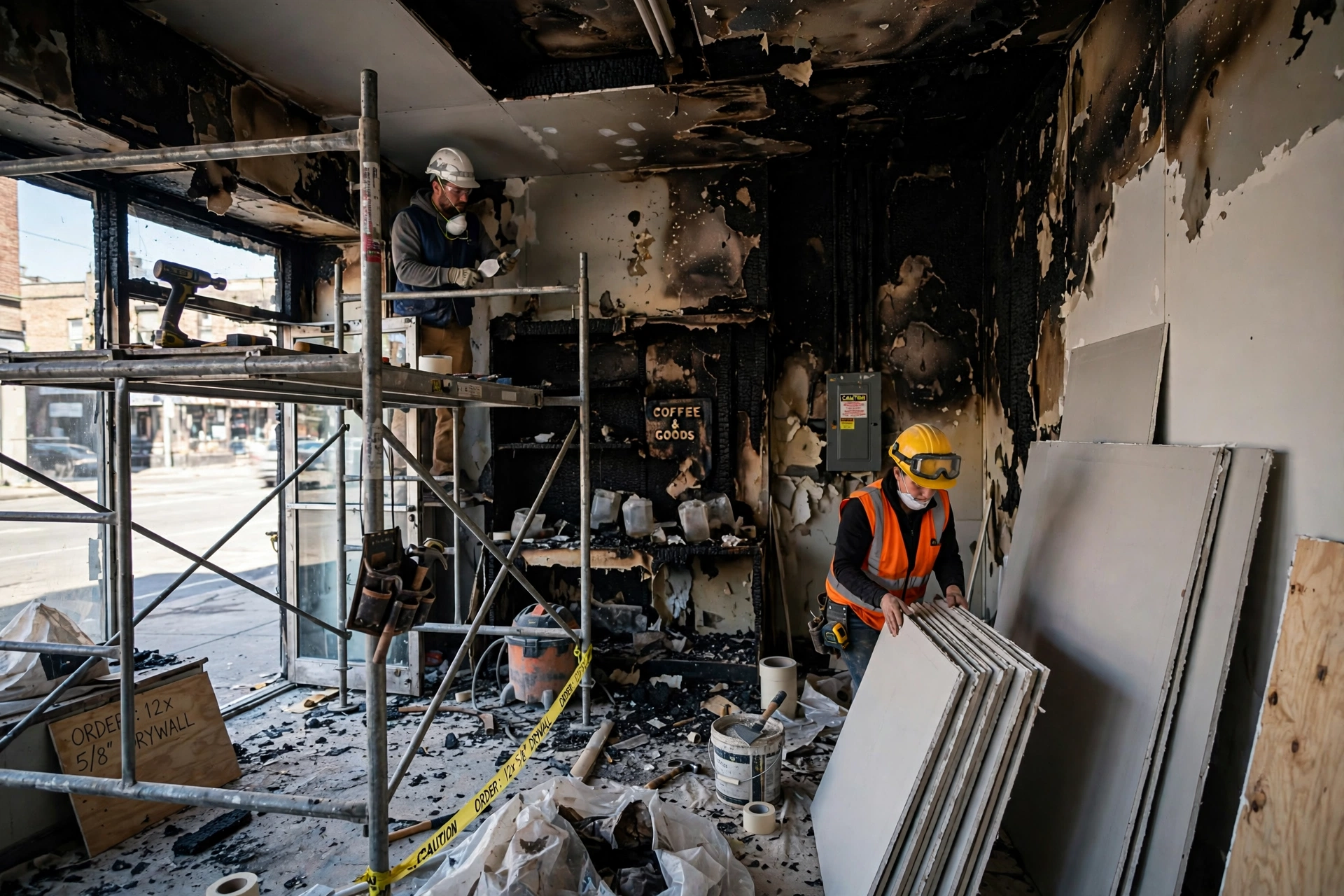
The covered perils are the ones your property insurance covers: fire, windstorm, hail, lightning, theft, vandalism and falling objects. The trigger is always direct physical loss to your property from a covered peril. No physical damage, no business interruption claim — which is where the exclusions begin to matter.
What It Does Not Cover
The exclusions are the reason business owners get angry at claim time, so they are worth knowing before you buy. Business interruption insurance almost always excludes:
Floods. Flood damage needs separate flood insurance, and a closure caused by flooding alone is not covered by a standard business interruption policy.
Pandemics. A closure caused by a pandemic, epidemic or government shutdown order is almost always excluded unless a specific endorsement has been added. Most small businesses learned this during COVID-19, when business interruption claims for pandemic closures were denied across the industry.
Closures without physical damage. If your business has to close because a supplier shut down, a road was closed, or customers stayed away — but your own property was not damaged — a standard policy does not pay. Contingent business interruption cover, discussed below, is the separate product for that risk.
Damage to utilities off your premises. If the power grid fails and your undamaged shop cannot open, a standard policy usually does not respond. Utility services endorsements exist, but they are not automatic.
Undamaged property and voluntary closures. The policy covers the period your damaged property is being restored. It does not cover a decision to close for other reasons.
If any of these risks worries you, ask your agent about the endorsement that covers it — and get the answer in writing before you assume you are protected.
The Waiting Period and the Period of Restoration
Instead of a traditional deductible, most business interruption policies use a waiting period: the number of hours or days after the event before coverage begins paying. The waiting period typically ranges from 24 to 72 hours, depending on the insurer and the policy, with 48 to 72 hours the most common for small businesses. Think of it as a deductible measured in time rather than money — one to three days of revenue you absorb yourself before the insurer starts paying.
After the waiting period, coverage runs through the period of restoration: the time it takes to repair or rebuild the damaged property and get the business back to the point where it can trade normally. The standard restoration period is 30 days, but it can be extended to as long as 360 days, according to the Insurance Information Institute. The indemnity period — the maximum length of time the insurer will pay for lost income and extra expenses — is usually set at 6 to 12 months on small-business policies, and businesses with longer recovery times, such as those needing extensive reconstruction or specialised equipment, can buy an extended period of indemnity.
Two practical points follow from this. First, a 30-day restoration period is not enough for a serious fire — a rebuild can take six months or more, and a policy that stops paying after 30 days leaves you exposed for the rest. Second, the clock on the waiting period starts at the event, not when you file the claim, so report the loss promptly and keep records from day one.
How Much Does Business Interruption Insurance Cost?
Business interruption insurance is usually not sold by itself, which makes a precise standalone price hard to pin down. The figures that exist are for the package it comes in or for the endorsement added to a property policy:
Most small businesses pay between $40 and $130 a month — $480 to $1,560 a year — for business interruption coverage, depending on location, industry and coverage needs.
Bought as part of a Business Owner’s Policy, the whole package typically runs $500 to $2,500 a year for a small business, and the median Business Owner’s Policy costs $83 a month, according to online insurance brokerage Insureon. That package includes business income coverage along with property and general liability insurance.
Standalone business interruption endorsements added to a commercial property policy typically run $40 to $100 a month.
What drives the price is the same set of factors that drives property insurance: your industry, your location, your revenue, the value of the property, and the length of the indemnity period you choose. A restaurant in a hurricane zone with a 12-month indemnity period pays more than a home-based consultancy with a 3-month period. A longer waiting period lowers the premium, just as a higher deductible does on other policies — but only choose a waiting period you can afford to fund yourself, because those first days are the ones when cash is tightest.
How Much Coverage Do You Need?
Underinsuring is the most common mistake, and it is an expensive one, because most policies pay in proportion to the limit you bought. The calculation starts with your gross earnings: the revenue you would lose if the business stopped trading, minus the expenses that would also stop. Take your last twelve months of financials, and work out the monthly gross profit. Then multiply by the number of months you would need to rebuild — not the optimistic number, the realistic one. A shop that needs new wiring, permits, stock and staff retraining is looking at six months at least, and a restaurant or manufacturer can need twelve.
Worked example: a small retail shop with $40,000 a month in revenue and $25,000 a month in continuing expenses — rent, payroll, loan payments — would need about $25,000 a month of cover, or $300,000 for a 12-month indemnity period. A policy with a $100,000 limit would pay for four months and leave eight months uncovered. The premium difference between a $100,000 limit and a $300,000 limit is usually far smaller than the gap in protection.
Three questions to ask your agent when you set the limit: does the limit cover a full 12 months of continuing expenses, does it include extra expense coverage for temporary premises, and is the limit based on current revenue or last year’s? A business that has grown 30% since its last renewal is underinsured by 30% if the limit was never updated.
Contingent Business Interruption: When the Problem Is Not Yours
Standard business interruption cover pays when your property is damaged. Contingent business interruption pays when someone else’s property is damaged and your business suffers anyway — a key supplier’s factory burns down, a major customer closes, or a utility failure shuts your area. It is a separate rider, not part of the standard policy, and it typically carries longer waiting periods of 7 to 14 days and strict sublimits on payouts. If your business depends on one supplier or one big customer, it is worth asking about. Pandemic-related supplier shutdown forms exist as a niche variant, with premiums typically running $850 to $3,200 a year for small-to-midsize businesses — but read the waiting period and the sublimits before you buy, because they are the parts that decide whether the cover actually helps.
How to Buy It
For most small businesses the simplest route is a Business Owner’s Policy, which bundles business interruption cover with property and liability insurance at a lower combined price than buying each separately. If you already have a commercial property policy, ask your agent to add a business income endorsement. Either way, review the policy once a year alongside your financials: update the limit when revenue grows, check the waiting period and the indemnity period, and confirm in writing which exclusions apply. The policy you bought when the business was half its current size is not the policy you need now.
The bottom line: business interruption insurance is the cover that pays the bills property insurance does not. It replaces lost income and keeps paying rent, payroll, loan payments and taxes while a covered disaster keeps your doors closed, after a waiting period of 24 to 72 hours and for a restoration period you choose — 12 months is the prudent choice for most small businesses. Bought inside a Business Owner’s Policy it typically costs a small business $500 to $2,500 a year in total. The expensive mistake is not the premium. It is buying a limit that runs out three months into a six-month rebuild.
A forced closure is one of the fastest ways costs pile up while revenue stops — see how small business costs are rising in 2026.