
Why Your Card Fees Are Higher Than the Rate You Were Quoted
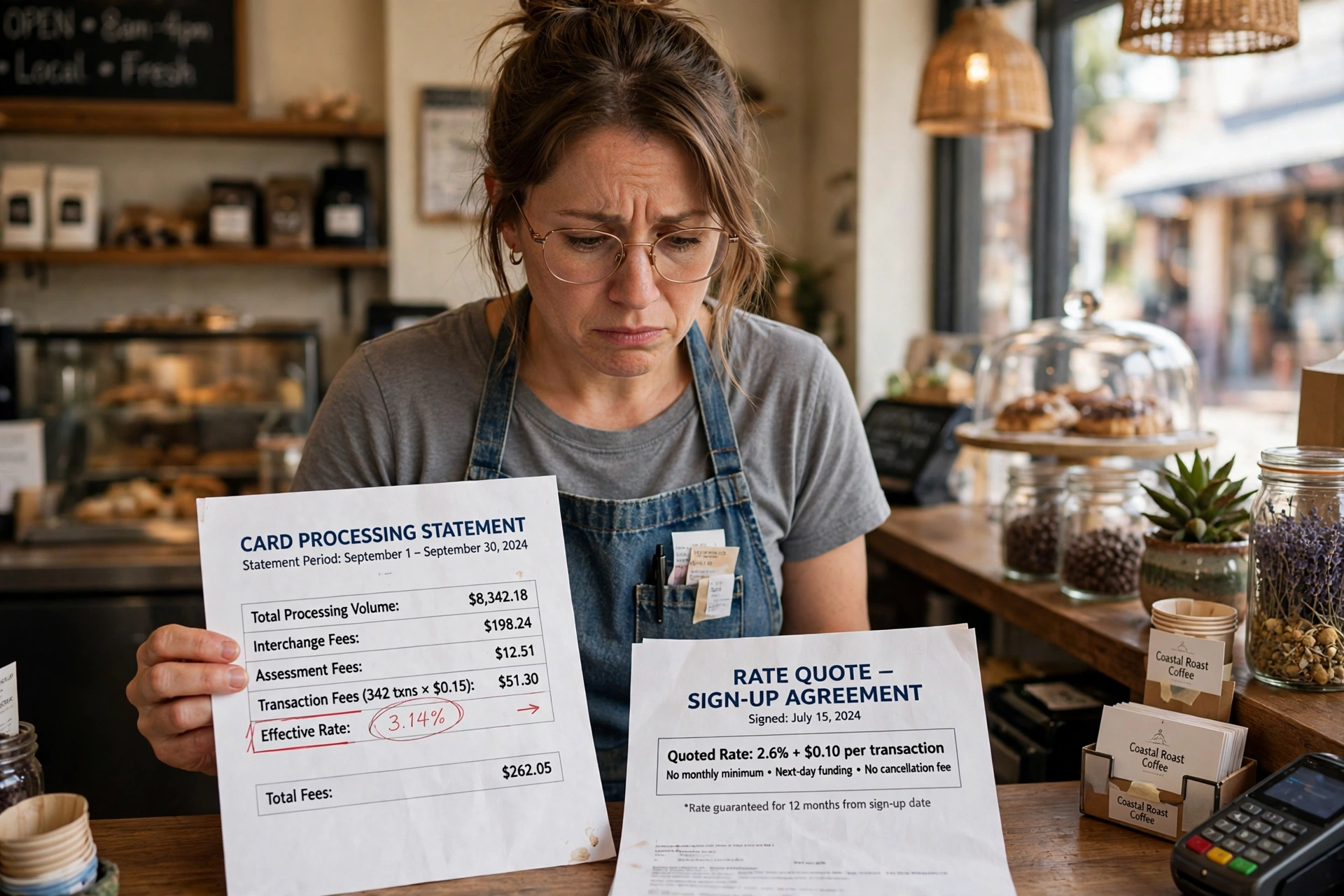
You signed up at 2.6%. The salesman said it twice, it was the biggest number on the brochure, and it is the number you have been quoting to yourself ever since: card payments cost you 2.6% of sales. Then your first full statement lands, you do the one calculation nobody did with you at sign-up — total fees divided by total card sales — and the answer is 3.4%.
Nothing went wrong, and you were probably not lied to. What happened is simpler: 2.6% was never the full price. It was one component of it, quoted in the format that makes it look smallest. The rest lives in a fixed fee per transaction, in the mix of cards and channels you actually take, and in charges that sit outside the rate entirely. This article takes a statement apart line by line, shows you how to compute the only rate that matters — your effective rate — and gives you a monthly audit habit that stops the gap widening quietly.
The example that starts most fee investigations
Take a small café doing $9,600 a month in card sales at an average ticket of $18.75. That is 512 transactions. Its processor charges the quoted flat rate of 2.6% plus 15 cents per transaction.
- Percentage fees: 2.6% of $9,600 = $249.60
- Fixed per-transaction fees: 512 × $0.15 = $76.80
- Total processing cost: $326.40
- Effective rate: $326.40 ÷ $9,600 = 3.4%
Every number on that statement is exactly what the contract said. The rate really is 2.6%. The business really did pay 3.4%. Both are true at once, because the quoted rate silently excluded 80 cents of every $100 the business took — the fixed fees, spread across small tickets. That gap is the subject of the rest of this article, and in most small businesses it is only the first of four reasons the real rate runs above the quoted one.
Reason 1: The fixed fee inflates the real rate, worst on small tickets
A percentage plus a fixed fee is two prices, not one
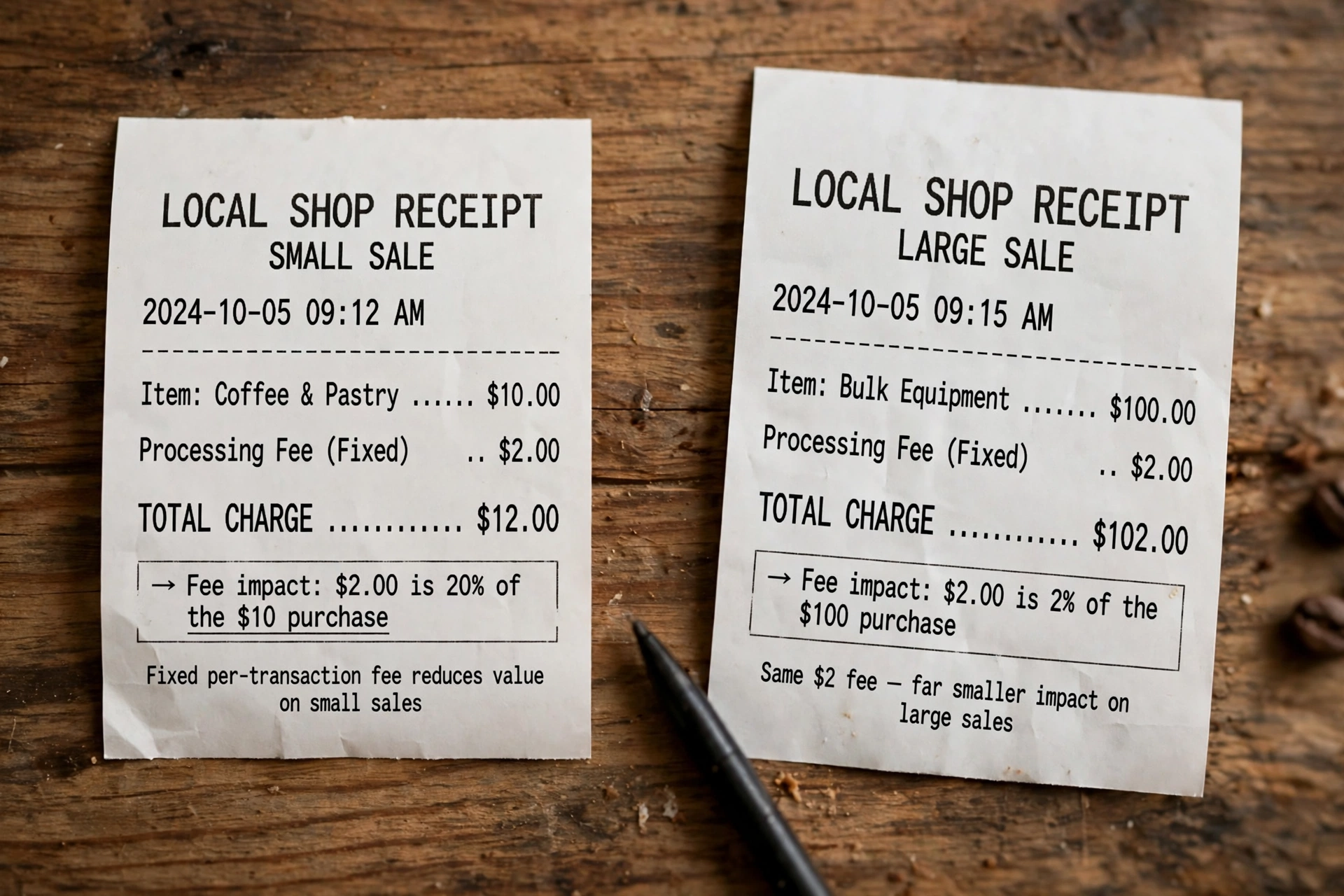
Almost every small-business pricing plan is a percentage plus a fixed amount per transaction: 2.6% + 15 cents, 2.9% + 30 cents, and so on. The percentage scales with the sale. The fixed fee does not. It takes the same 15 cents from a $5 sale as from a $500 sale, which means its weight in your real rate depends entirely on your average ticket.
Run Square’s free-plan in-person rate — 2.6% plus 15 cents, per Square’s published fee schedule — at three ticket sizes:
- On a $10 sale: $0.26 percentage + $0.15 fixed = $0.41. Effective rate: 4.1%.
- On a $50 sale: $1.30 + $0.15 = $1.45. Effective rate: 2.9%.
- On a $100 sale: $2.60 + $0.15 = $2.75. Effective rate: 2.75%.
Same plan, same quoted rate, three different real prices. The café above lands at 3.4% because its average ticket is under $20: the fixed fee alone contributes 0.8 percentage points ($0.15 divided by an $18.75 ticket). A business with a $100 average ticket on the identical plan contributes only 0.15 points and pays 2.75%.
The rule this creates
The smaller your average ticket, the more the cents figure matters and the less the percentage does. A coffee shop comparing 2.6% + 15¢ against 2.9% + 5¢ should notice the second plan’s fixed fee is a third of the first — on a $10 ticket it costs $0.34 against $0.41. A jeweller with a $400 ticket runs the comparison the other way: the fixed fee nearly vanishes, and the percentage decides everything. There is no cheapest plan in the abstract — only a cheapest plan at your ticket size. Every honest fee comparison starts from your average sale, not a brochure.
Reason 2: Your card and channel mix reprices you every day
Not all cards cost the same underneath
If you are on flat-rate pricing, you pay the same blended rate whatever card a customer presents — the processor absorbs the differences and prices the blend to cover its most expensive days. If you are on interchange-plus pricing, those differences land on you directly, because you pay each card’s actual interchange rate plus your processor’s markup.
Interchange — the fee set by the card networks and paid to the customer’s bank — varies enormously by card. Regulated debit cards carry a very low rate. Basic credit cards sit in the middle. Premium rewards cards, the ones giving customers cashback and airline miles, sit at the top, because those rewards are funded out of the interchange you pay. Two cafés with identical sales and identical contracts can pay different effective rates on interchange-plus purely because one neighbourhood pays with debit cards and the other with rewards credit cards.
The channel changes the price too
How the card is taken matters as much as which card it is. Card-present payments — tap, dip or swipe, with the card physically there — are the cheapest, because fraud is rare. Card-not-present payments price higher, because the risk travels with them. Square’s published fee schedule for its free plan in 2026 makes the ladder explicit:
- In person (tap, dip or swipe): 2.6% + 15¢
- Online checkout or invoice: 3.3% + 30¢
- Manually keyed in: 3.5% + 15¢
Stripe’s published online rate is 2.9% + 30¢ — cheaper than Square’s online rate, dearer than its in-person rate, which is exactly the point: “your rate” is really a menu of rates, and your statement averages whichever ones customers actually used. A business that drifts from counter sales toward invoices, payment links and phone orders will watch its effective rate climb though its contract never changed. The café at 3.4% might find a third of its volume moved online at 3.3% + 30¢ — a change in customer behaviour, not pricing, and one it can answer by steering regulars back to tap-to-pay at the counter.
Reason 3: The fees that live outside the rate entirely
Even a perfect understanding of percentage, fixed fee and channel will understate your cost if you stop at processing lines. Several real charges sit outside the rate you were quoted.
Monthly and account fees
Paid plans and traditional merchant accounts add monthly charges: Square’s Plus plan costs $49 a month per location per its published pricing, before a single card is taken. Gateway, PCI compliance, statement and minimum monthly fees appear on many traditional accounts. None show up in a rate quote, and all belong in your effective-rate maths, because they are part of what accepting cards cost you that month.
Instant transfers: 1.75% for impatience
Standard payouts to your bank are generally free and take a day or two. Instant transfers are a separate service — 1.75% of the amount transferred on Square’s published schedule. Transfer a $1,000 payout instantly and you pay $17.50 for the speed: more, on that money, than the processing fee on the sales that created it. A business pulling instant transfers several times a week pays a second, voluntary processing rate on top of the first.
Chargebacks and buy-now-pay-later
A disputed payment claws the full sale amount back out of your account while the case is investigated, and many processors add a per-dispute handling fee on top. The money may return if you win — the time and the fee do not. Separately, buy-now-pay-later carries a much higher rate: Afterpay through Square is 6% + 30¢ per its published schedule. On a $100 sale that is $6.30, against $2.75 for an in-person card payment. It may be worth it for the conversion on a big-ticket item — but it should be a deliberate marketing spend, not an invisible part of “the rate.”
How to compute your real effective rate from a statement
The one formula that ends the argument
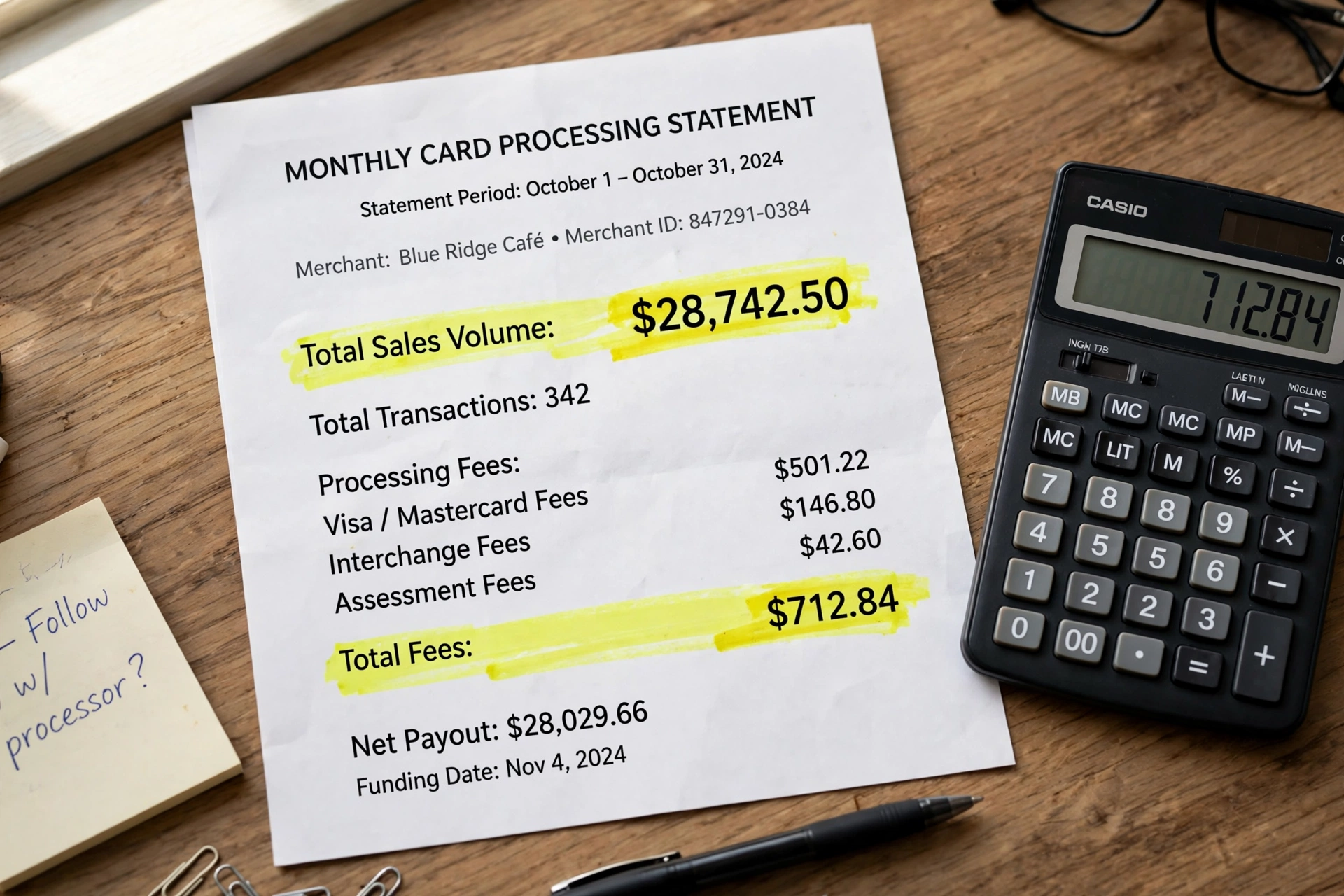
Forget the quoted rate for a moment. Your effective rate for any month is:
Total of every fee on the statement ÷ total card volume for the month × 100
Every fee means every fee: processing percentages, per-transaction charges, monthly plan fees, instant-transfer charges, dispute fees. If it left your account because you accept cards, it goes in the top number. The bottom number is the gross card volume those fees were charged on.
The same business, four pricing models
Here is one month — $10,000 in card volume, a $50 average ticket, 200 transactions — priced under four common models, using published 2026 rates. This is the comparison to reproduce with your own numbers; the Credit Card Processing Fee Calculator runs all four models at your own volume and ticket size, so you can see which one your current statement is closest to — and which one would have been cheaper.
- Flat rate, 2.6% + $0.15 (Square in-person, free plan): percentage $260.00 + fixed fees 200 × $0.15 = $30.00. Total $290.00 → 2.90% effective.
- Square online, 3.3% + $0.30: percentage $330.00 + fixed fees 200 × $0.30 = $60.00. Total $390.00 → 3.90% effective.
- Stripe online, 2.9% + $0.30: percentage $290.00 + fixed fees $60.00. Total $350.00 → 3.50% effective.
- Interchange-plus, at a 1.8% average interchange + 0.30% processor markup + $0.10: combined percentage 2.10% = $210.00 + fixed fees 200 × $0.10 = $20.00. Total $230.00 → 2.30% effective.
Read the table from your own statement’s point of view. If your effective rate came out at 3.4% on the first model, your ticket size or channel mix is doing the damage. If you are on an online rate but most sales happen at a counter, the model itself is the problem — and the easiest to fix. Note what the interchange-plus line assumes: a 1.8% average interchange. A rewards-heavy mix pushes that average up and narrows the gap, which is why interchange-plus quotes built on a low assumed average deserve the same suspicion as any headline rate.
When each model wins
Flat rate wins at low volume and where predictability matters. The blend protects you from your card mix, the bill is easy to forecast, and at a few thousand dollars a month the gap between models is a few dollars — not worth complexity.
Interchange-plus wins as volume and average ticket grow. The markup is thinner than the margin built into blended rates, big tickets dilute its per-transaction fee, and the statement shows what each card type costs. Its risk is the mirror of flat rate’s comfort: your bill moves with your customers’ cards.
Online flat rates win when the channel is genuinely online and volume is modest — an invoice-based business on Stripe’s 2.9% + 30¢ or Square’s online rate buys simplicity at a fair price for card-not-present risk. They lose when a business pays online rates for counter sales out of habit.
And the café’s rule, worth taping to the register: small tickets, watch the cents; big tickets, watch the percentage. Every pricing decision you make — plan, model, channel — is that rule applied to your own average sale.
The 5-step monthly fee audit
Rates drift because mixes drift and habits form. Fifteen minutes a month stops it. Work through the same five steps, in order, statement in hand.
- Compute your effective rate. Total fees divided by total volume, all fees included, exactly as above. Write the percentage down where you will see next month’s beside it.
- Split the bill into its three parts. Percentage fees, fixed per-transaction fees, and everything else (monthly fees, transfers, disputes). Whichever part grew is where next month’s question lives.
- Check your average ticket and channel mix. Divide volume by transaction count for the ticket; glance at the in-person versus online versus keyed split. A falling ticket or a rising online share explains most rate creep without any contract change.
- Hunt the outside-the-rate charges. Count instant transfers and dispute fees for the month and total them. These are the most actionable lines on the statement — transfer habits and dispute evidence can both be fixed this week.
- Re-price one alternative. Once a quarter, take the same month’s volume and ticket and run it through one competing model — flat against interchange-plus, or your current processor against its main rival — using the calculator linked above. You are not switching every quarter; you are making sure the gap between what you pay and what you could pay stays small enough to ignore.
Do this monthly and you will catch the two most common leaks — channel drift and fixed-fee weight on small tickets — within a month of them starting.
Frequently asked questions
Why is my effective rate higher than my contract rate?
Because the contract rate is usually only the percentage. Your effective rate also includes the per-transaction fixed fee (which inflates the rate most on small tickets), the channel mix you actually took payments through, and the charges outside the rate — monthly fees, instant transfers and disputes. Effective rate is total fees divided by total volume; that is the number to compare month to month.
Is a lower percentage always cheaper?
No. Compare the whole formula at your average ticket. On a $10 sale, 2.6% + 15¢ costs 41 cents (4.1% effective) while 2.9% + 5¢ costs 34 cents — the “higher” rate is cheaper. On a $500 sale the same two plans cost $13.15 and $14.55, and the percentage-led plan wins. Ticket size decides which part of the formula matters.
Why did my rate go up when my contract did not change?
Usually your mix changed, not your pricing: more online or keyed-in payments instead of in-person, more premium rewards cards in the mix (decisive on interchange-plus), a falling average ticket, or new outside-the-rate habits such as frequent instant transfers. The monthly audit above separates these causes because each one shows up in a different part of the bill.
Should I switch to interchange-plus to cut my fees?
At the worked example’s volume — $10,000 a month at a $50 ticket — interchange-plus priced at a 1.8% average interchange plus a 0.30% markup came to $230 against $290 for flat rate, a $60 monthly saving before any monthly account fees. The saving grows with volume and ticket size and shrinks if your card mix is rewards-heavy. Run your own month’s numbers through both models, including every fee, and switch only if the gap survives that full comparison.