How Much Does Square Charge Per Transaction in 2026? US Rates by Payment Type, Worked Out in Dollars
How much does Square charge per transaction? On its free plan, Square charges 2.6% plus 15 cents for an in-person card payment, 3.3% plus 30 cents for an online checkout or invoice, and 3.5% plus 15 cents when you type the card number in by hand. There is no monthly fee on the free plan, and cash and cheques cost nothing to accept.
That short answer hides the part that actually costs small businesses money: the rate changes with how the card is taken, and several guides still quote the old numbers. Square’s free online rate rose to 3.3% plus 30 cents, and the in-person rate is now 2.6% plus 15 cents, not the 2.6% plus 10 cents older articles still show. This guide uses Square’s published US fee schedule as of late 2026, works every rate out in dollars on real sale sizes, and shows exactly when the paid plans start saving you money.
The short answer: every Square rate in one table
| Payment type | Square Free ($0/mo) | Square Plus ($49/mo per location) | Square Premium ($149/mo per location) |
|---|---|---|---|
| In person — tap, dip or swipe | 2.6% + 15¢ | 2.5% + 15¢ | 2.4% + 15¢ |
| Online checkout or invoice | 3.3% + 30¢ | 2.9% + 30¢ | 2.9% + 30¢ |
| Online through Square’s Payments API | 2.9% + 30¢ | 2.9% + 30¢ | 2.9% + 30¢ |
| Manually entered card or card on file | 3.5% + 15¢ | 3.5% + 15¢ | 3.5% + 15¢ |
| Afterpay (buy now, pay later) | 6% + 30¢ | 6% + 30¢ | 6% + 30¢ |
Square replaced 18 separate subscriptions with these three plans in October 2025. If your account still sits on an older plan, the rates above may not match what you are actually charged — check your own Square Dashboard under Settings, then Account and Settings, then Pricing and subscriptions. Rates change, and Square says existing sellers’ pricing can differ from the published table.
Two details in the table catch people out. First, the online rate on the free plan is 3.3% plus 30 cents, not 2.9%. The 2.9% online rate applies on Plus and Premium, or when a developer takes the payment through Square’s API. Second, manually keyed cards cost 3.5% plus 15 cents on every plan — paying $49 or $149 a month does not reduce that rate at all.
Worked out in dollars: what Square takes from real sales
Percentages hide the real cost. Here is what Square takes from a sale at four common sizes, on the free plan.
A $10 sale. In person: 26 cents plus 15 cents is 41 cents, and you keep $9.59. That is an effective rate of 4.1 percent — the fixed 15 cents bites hard on small sales. Online: 33 cents plus 30 cents is 63 cents, and you keep $9.37. Keyed in: 35 cents plus 15 cents is 50 cents, and you keep $9.50.
A $50 sale. In person: $1.30 plus 15 cents is $1.45, and you keep $48.55. Online: $1.65 plus 30 cents is $1.95, and you keep $48.05. Keyed in: $1.75 plus 15 cents is $1.90, and you keep $48.10.
A $100 sale. In person: $2.60 plus 15 cents is $2.75, and you keep $97.25. Online: $3.30 plus 30 cents is $3.60, and you keep $96.40. Keyed in: $3.50 plus 15 cents is $3.65, and you keep $96.35. Through the API: $2.90 plus 30 cents is $3.20, and you keep $96.80.
A $500 sale. In person: $13.00 plus 15 cents is $13.15, and you keep $486.85. Online: $16.50 plus 30 cents is $16.80, and you keep $483.20. Keyed in: $17.50 plus 15 cents is $17.65, and you keep $482.35.
The pattern is consistent: the online rate costs about 85 cents more than the in-person rate on a $100 sale, and the gap grows with the sale size. A business doing $10,000 a month online on the free plan pays $360 in fees; the same volume in person costs $275. That $85 monthly difference is the whole case for the paid plans — and for steering customers toward the card reader wherever possible.
The fixed fee also punishes small tickets. On a $10 sale the effective in-person rate is 4.1 percent, nearly double the headline 2.6 percent. Coffee shops and market stalls with low average tickets feel this more than anyone. The comparison with other selling costs is instructive: eBay selling fees work the same way, with a percentage plus a fixed per-order charge that stings hardest on cheap items.
In person vs online: why the rate changes
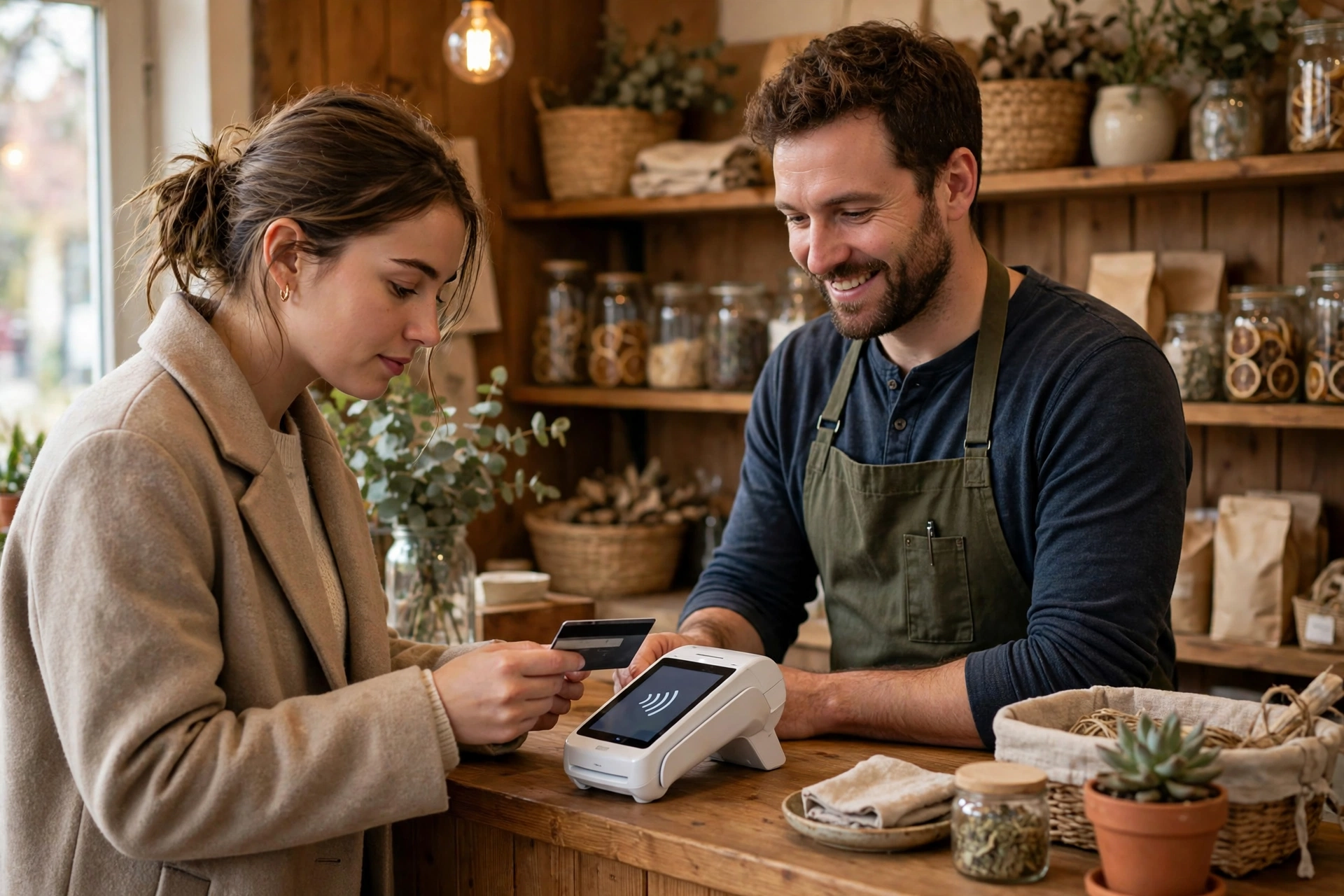
Square charges less in person because the risk is lower. When a customer taps or dips a card in front of you, the card is present, the chip or contactless token verifies it, and the chance of a fraudulent chargeback is small. When a customer pays online, the card is not present, anyone could be typing the number, and the processor prices in that risk. Manually keyed cards sit in the middle on risk but at the top on price, because typing a number in means the card was not read at all — the exact pattern stolen-card fraud follows.
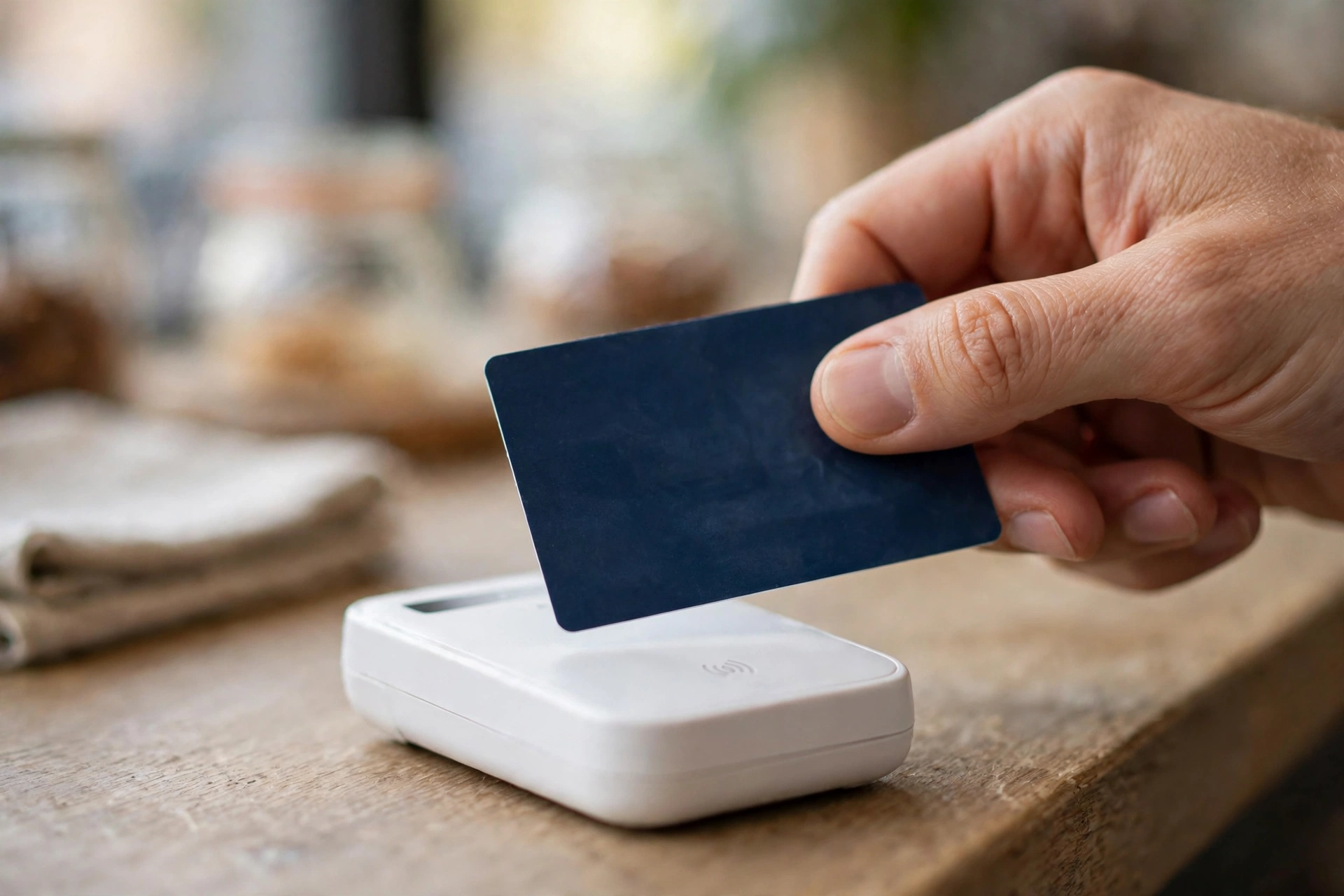
This is also why Square’s rates look different from a processor that charges one flat rate for everything. Square is showing you the risk in the price. A business that takes most payments face to face gets the cheapest rate most of the time; a business that takes most payments through invoices or an online store pays the higher card-not-present rate on nearly every sale.
Square Plus and Premium: when the monthly fee pays for itself
Plus costs $49 a month per location and Premium costs $149 a month per location. Both lower the in-person rate by a tenth of a percentage point per step and the online rate from 3.3% to 2.9%. The question is how much volume you need before the saving covers the fee.
For in-person sales, Plus saves 0.1 percent — one tenth of a cent per dollar. To save $49 a month at that rate, you need $49,000 a month in card-present volume. Almost no small business should buy Plus for the in-person rate alone.
For online sales, the maths is far kinder. Plus saves 0.4 percent on every online or invoice payment. To save $49 a month at that rate, you need $12,250 a month in online volume. A business invoicing $15,000 a month online saves $60 in fees and pays $49 for Plus — a net gain of $11 a month, plus the extra features Plus bundles. At $25,000 a month online, the saving is $100 against a $49 fee.
Premium is harder to justify on processing alone. Its in-person rate is 0.2 percent below Free, so breaking even on card-present volume takes $74,500 a month. Against Plus, the extra $100 a month buys another 0.1 percent in person and nothing online, since both charge 2.9% plus 30 cents for online payments. Premium makes sense for its bundled features — advanced reporting, more locations support and priority help — not for the rate cut.
The rule of thumb: if your online and invoice volume is above roughly $12,000 a month, Plus pays for itself. Below that, stay on Free and put the $49 toward something else.
The fees people miss
The per-transaction rate is not the whole bill. Four other charges surprise new Square sellers.
Instant transfers. Standard transfers to your bank are free and take one to two business days. If you want the money immediately, Square’s instant transfer fee is 1.75% of the amount transferred. On a $1,000 payout that is $17.50 — more than the processing fee on the sales that earned it. Use standard transfers unless the cash is genuinely urgent.
Hardware. The card reader and terminal are one-off purchases, not rentals. The Square Reader costs $49 and the Square Terminal costs $299. Both pay for themselves quickly against the keyed-in rate: every sale you tap instead of type saves about 0.9 percent, so a $49 reader pays for itself after roughly $5,400 in sales that would otherwise have been keyed in.
Afterpay. Square’s buy-now-pay-later option charges 6% plus 30 cents per transaction — roughly double the standard online rate. It can lift conversion on big-ticket sales, but on a $100 sale it takes $6.30, against $3.60 for a normal online payment. Treat it as a marketing cost, not a payment method.
Chargebacks. A disputed payment claws back the full sale amount while Square investigates, and the money can be held for weeks. Keep receipts, delivery confirmations and signed invoices, because the evidence you can produce is what decides a dispute. The best defence is boring: clear receipts, accurate descriptions, and prompt replies to unhappy customers before they go to their bank.
Square vs Stripe on a $50 sale
Stripe is the comparison most small businesses make, and on a $50 sale the two are nearly tied — with one telling difference.
Stripe charges 2.7% plus 5 cents in person and 2.9% plus 30 cents online, with no monthly fee and no cheaper paid tier for small volumes. On a $50 in-person sale, Stripe takes $1.40 and Square takes $1.45 — Stripe wins by five cents. On a $100 in-person sale, both take $2.75 exactly. On a $500 in-person sale, Stripe takes $13.55 and Square takes $13.15 — Square wins by 40 cents, because its fixed fee is higher but its percentage is lower, and the percentage dominates as the sale grows.
Online, Stripe’s 2.9% plus 30 cents beats Square Free’s 3.3% plus 30 cents on every sale, and ties Square Plus and Premium exactly. So the honest comparison is this: Square wins for in-person sales over $100, Stripe wins for small in-person sales and for online sales on the free tier, and the paid Square plans erase Stripe’s online advantage once your volume justifies $49 a month.
The deeper difference is not price. Square is a full point-of-sale system — hardware, inventory, invoices and online store in one account. Stripe is a payments platform that needs other software around it. A shop that wants one system usually picks Square; a website that wants a checkout API usually picks Stripe.
How to pay less
Four habits cut a Square bill without changing plans.

First, take the card in person whenever you can. Tap, dip or swipe beats online by 0.7 percent and beats keyed-in by 0.9 percent on every sale. Second, stop typing card numbers in. If a regular customer pays by phone, save their card on file through Square’s secure card-on-file feature rather than re-keying it — though note the card-on-file rate is the same 3.5% plus 15 cents, so the real fix is getting the customer to tap in person or pay through a payment link. Third, check whether your online volume has crossed $12,250 a month — that is the point where Plus starts paying for itself. Fourth, use standard bank transfers, not instant transfers, and treat the 1.75% instant fee as an emergency cost.
The bottom line
Square charges 2.6% plus 15 cents in person and 3.3% plus 30 cents online on its free plan, with 3.5% plus 15 cents for keyed-in cards and 2.9% plus 30 cents through its API. Plus at $49 a month pays for itself once online volume passes about $12,250 a month; Premium at $149 a month is a features decision, not a rates decision. For most small businesses, the free plan is the right start, the card reader is the best money you will spend, and the single most expensive habit is typing card numbers in by hand.
Frequently asked questions
How much does Square charge per transaction?
On the free plan, 2.6% plus 15 cents in person, 3.3% plus 30 cents for online checkout or invoices, 2.9% plus 30 cents through the Payments API, and 3.5% plus 15 cents for manually entered cards or cards on file.
Is there a monthly fee for Square?
No, on the free plan. Square Plus costs $49 a month per location and Square Premium costs $149 a month per location, and both lower the processing rates.
What is the cheapest way to take a payment on Square?
In person, with a tap, dip or swipe: 2.6% plus 15 cents on the free plan. Online payments and keyed-in cards always cost more.
When does Square Plus pay for itself?
When your online and invoice volume passes about $12,250 a month, because Plus cuts the online rate from 3.3% to 2.9% — a 0.4 percent saving that covers the $49 fee at that volume. For in-person-only volume, it takes about $49,000 a month.
Does Square charge for cash payments?
No. Cash and cheques are free to accept. Square only charges on card and digital-wallet payments.
Square vs Stripe: which is cheaper?
It depends on the sale. Stripe is cheaper for small in-person sales and for online sales against Square’s free plan. Square is cheaper for in-person sales over $100, and its Plus and Premium plans match Stripe’s online rate.
Rates (text only, no links in content): Square published US fee schedule and pricing page, checked October–November 2026; Stripe published pricing for comparison.