

How Much Does a Trademark Cost a Small Business in 2026? USPTO Fees, Per Class, With Real Totals
If you run a small business in the United States and you are wondering how much does a trademark cost for a small business, the short answer is simple: the U.S. Patent and Trademark Office (USPTO) charges $350 per class of goods or services to file a federal trademark application in 2026, so a careful one-class filing costs exactly $350. Owners hear different numbers — $350, $1,000, $2,500 — because the filing fee is only the first line of the bill. This guide works through every fee, with real totals for one, two and three classes.
The Short Answer: Three Budget Bands
A do-it-yourself filing for a single class costs $350. Two classes cost $700; three cost $1,050. Hire a trademark attorney and the typical all-in total for one class runs $850 to $2,000, because flat attorney fees generally run $500 to $1,500 on top of the $350 fee (ContractsCounsel survey). An online filing service usually lands between about $400 and $1,250, charging roughly $49 to $899 on top of the USPTO fee. None of those totals includes answering a refusal, proving use later, or renewal fees — and no government fee is refundable.
What a Trademark Class Is — and Why It Decides Your Bill
A trademark does not protect a name in the abstract. It protects a name, logo or slogan in connection with specific goods or services, and the USPTO sorts all goods and services into 45 classes: Classes 1 to 34 cover goods, Classes 35 to 45 cover services. You pay $350 once per class, not once per trademark: Class 30 for your coffee brand is $350; add Class 35 for your online store, $700; add branded T-shirts under Class 25, $1,050. Most small businesses need one or two classes. Filing in classes you do not use wastes $350 per class at filing and $325 at each renewal; filing too narrowly lets a competitor legally use your name for a related product.
If you file yourself, pick pre-approved descriptions from the USPTO’s Trademark ID Manual: the $350 base fee only applies with ID Manual wording and complete information. Write your own description and the USPTO adds $200 per class; leave information out and it adds $100 per class. Those surcharges are entirely avoidable, and they are the most common reason a “$350 filing” quietly becomes a $550 filing.

How Much Does a Trademark Cost for a Small Business? The Full 2026 Fee Table
All figures below come from the USPTO fee schedule in force since January 18, 2025. All amounts are per class, for electronic filing.
| Fee item | Amount (per class) | When you pay it |
|---|---|---|
| Base application (Sections 1 and 44) | $350 | When you file |
| Insufficient information surcharge | +$100 | At filing, if required information is missing |
| Free-form text box instead of ID Manual wording | +$200 | At filing, if you write your own goods/services description |
| Each additional 1,000 characters of free-form text | +$200 | At filing, beyond the first 1,000 characters |
| Statement of Use / Amendment to Allege Use | $150 | Later, only for intent-to-use filings |
| Six-month extension to file a Statement of Use | $125 | Only if you need more time to show use |
| Section 8 declaration of use | $325 | Between years 5 and 6 after registration |
| Section 15 declaration of incontestability | $250 | After 5 years of continuous use (optional) |
| Section 9 renewal | $325 | Every 10 years |
| Combined Section 8 + Section 9 (10-year renewal) | $650 | Between years 9 and 10 |
| Grace period fee (Section 8 or Section 9) | +$100 | If filed in the 6-month grace period |
| Petition to revive an abandoned application | $250 | If your application goes abandoned |
| TTAB ex parte appeal | $225 | If you appeal a final refusal |
| Madrid Protocol designation of the US (Section 66(a)) | $600 | When designating the US through WIPO |
There is no separate “registration fee” — the $350 fee is the only government charge.
Worked Totals: What a Small Business Actually Pays
One class, already in use, filed carefully yourself. A candle maker selling under Class 4 picks the ID Manual description and completes every field. Total: $350, unless the USPTO issues an Office Action.
Two classes, filed yourself, with a free-form description. A coffee roaster files Class 30 for beans and Class 35 for online retail but writes a custom description. Base fee $700 (2 x $350), plus $400 in free-form surcharges (2 x $200). Total: $1,100 — $700 with ID Manual wording.
Three classes, intent-to-use, with an attorney. A skincare startup files three classes before launch with a flat-fee attorney ($900) and a $400 clearance search. Government fees: $1,050 at filing, plus a $450 Statement of Use (3 x $150) once products launch. Total through registration: $2,800 — or $3,300 with a $500 Office Action response.
The Surcharges That Catch People Out
The USPTO’s January 2025 fee restructuring made sloppy applications expensive. The $350 base fee assumes a clean application: complete information, and goods and services described with the ID Manual’s pre-approved wording. Deviate, and the surcharges stack per class — $100 for missing information, $200 for the free-form text box, plus another $200 for each additional group of 1,000 characters beyond the first 1,000. On a three-class application with a long custom description, surcharges alone can exceed $1,000 — so find the closest pre-approved ID Manual description before you file.
DIY vs. Attorney vs. Filing Service
No law requires a US-based business to hire a lawyer — the USPTO says so plainly, while strongly encouraging it. Applicants based outside the US must use a US-licensed attorney. Filing yourself costs $350 for one clean class, but the traps are real: the wrong filing basis, goods described too broadly or too narrowly, a descriptive mark, or a conflicting registration a search would have found. Only about 36 percent of applications are approved on first review (USPTO data, Q3 2026).
An online filing service sits in the middle, charging roughly $49 to $899 plus the USPTO fee to handle the form-filling — but it generally will not give legal advice, assess your mark’s risk, or respond to an Office Action, and anyone who files for you must be a US-licensed attorney. An attorney’s flat fee for a straightforward single-class filing typically runs $500 to $1,500, plus $300 to $800 for a clearance search — buying a proper search, a risk assessment, and an examiner-ready application. For a business whose name is its main asset, that is usually money well spent; for an unproven side project, the $350 DIY route is a reasonable bet.
The Search: The Step That Protects Your $350
The USPTO does not search for you before taking your money, and it does not refund the fee if a conflicting mark already exists. The free starting point is the USPTO’s own trademark search system, where you can look for identical and similar marks in your classes. But it is not a complete clearance search: it misses unregistered common-law uses, state registrations, business names and domain names, and a competitor using the same name without a federal registration can still block you. A professional clearance search, typically $300 to $800 through an attorney, covers those sources with an opinion on the risk — answering the only question that matters before you pay.
What Happens If Your Application Is Refused
USPTO application fees are non-refundable. If your application is refused, or abandoned because you missed a deadline, the $350 per class is gone — no refund, no credit toward a second try; refiling means paying again. Most refusals arrive as an Office Action from the examining attorney. The common grounds are likelihood of confusion with an existing mark, and descriptiveness — the mark merely describes the goods rather than identifying their source. You generally have three months to respond, with a possible three-month extension for $125 per class. A simple response, such as agreeing to a disclaimer, may cost $300 to $500 through an attorney; a substantive likelihood-of-confusion response typically costs $500 to $1,500.
A final refusal can be appealed to the Trademark Trial and Appeal Board for $225 per class; an abandoned application can be revived by petition for $250. Expect the process to take time: the USPTO’s October 1, 2026 snapshot shows an average of 4.3 months to the first examining action and about 10.4 months from filing to registration or abandonment. A clean application typically registers in 6 to 10 months.
Keeping Your Trademark: Maintenance and Renewal Fees
A federal registration lasts ten years and can be renewed indefinitely — but only if you keep using the mark and file the maintenance paperwork on time. Between the fifth and sixth years after registration, you must file a Section 8 declaration of use, swearing you are still using the mark. The USPTO fee is $325 per class. Many owners also file an optional Section 15 declaration at the same time, for $250 per class. Miss the Section 8 deadline and there is a six-month grace period for an extra $100 per class; miss that, and the registration is cancelled.
Between the ninth and tenth years, file a combined Section 8 and Section 9 renewal for $650 per class (same $100 grace fee if late), then repeat every ten years. For one class, ten-year maintenance totals $975; for three classes, $2,925. Put the deadlines in your calendar the day the certificate arrives — letting a registration die for want of a $325 filing is the most expensive mistake here.
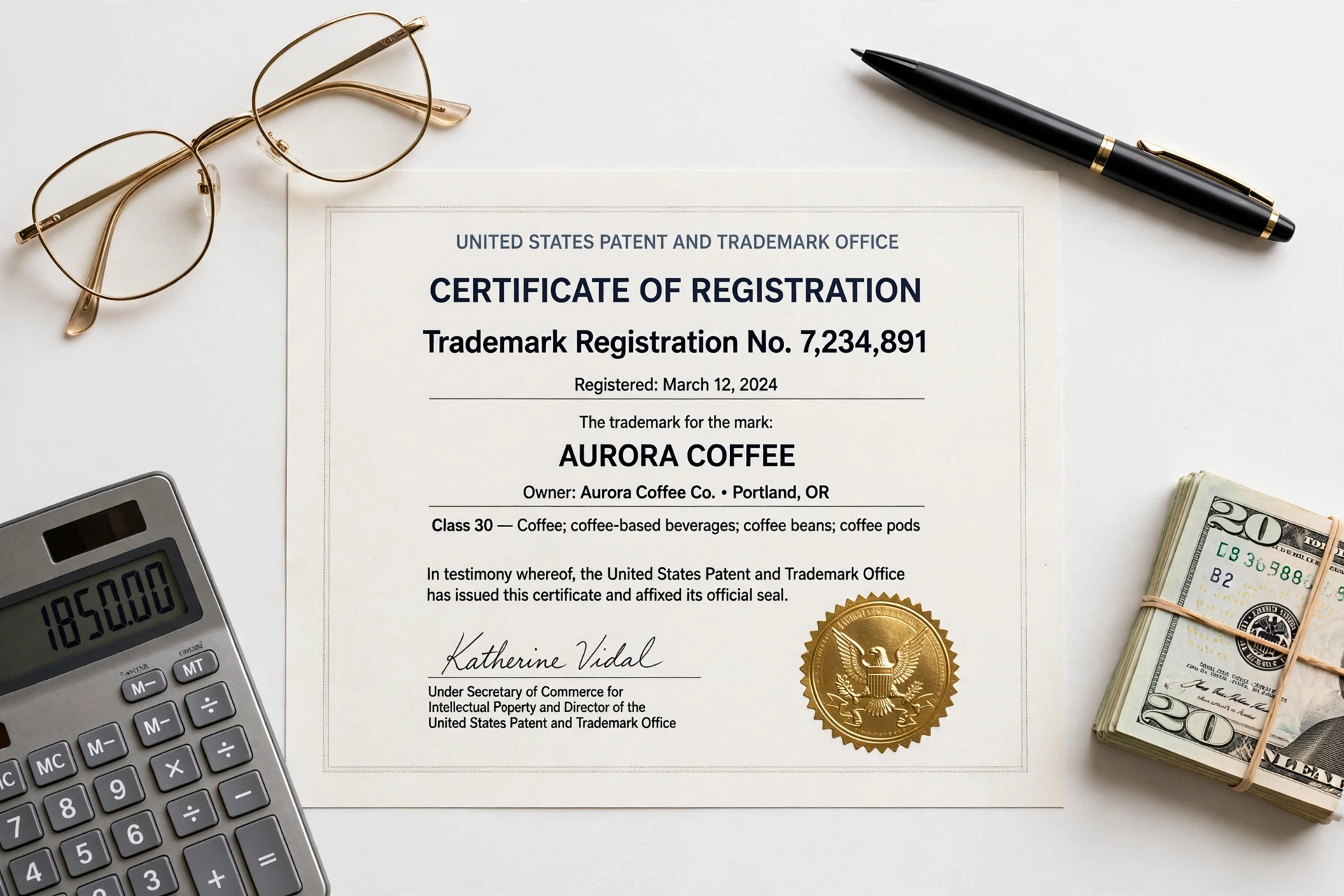
Federal vs. State Trademark — and Why an LLC or DBA Is Not a Trademark
A common and costly confusion is the belief that registering a business name with the state protects the brand. It does not. Forming an LLC, registering a DBA name, or getting a business license lets you operate under that name in your state — but gives no exclusive right to it, and does not stop someone else, in another state or a different line of business, from using it. Understanding the difference between a DBA and an LLC matters here, because neither one is a trademark, and neither substitutes for a federal filing.
A state registration is a separate, cheaper option — most states charge $50 to $100 — but it protects the mark only within that state, which is enough for a business that will only ever trade locally. For any business that sells online or plans to grow, a federal registration is what matters: nationwide coverage, the right to sue in federal court, and a public record that deters copycats. Where you form your business matters, too: the state affects your taxes, annual fees and compliance burden, and owners regularly regret forming your LLC in the wrong state once the franchise taxes and registered-agent bills arrive. Sort out the entity first, then protect the name that sits on it.
Is It Worth It for a Small Business?
For most small businesses, the answer is yes — but not always right away. A federal trademark is worth the $350 when the name is the business: when customers find you by the name, when it appears on packaging or a storefront, or when you are investing in a website or product line built around it. The $350 fee is small next to rebranding after a cease-and-desist letter, which routinely runs into thousands of dollars.
It is reasonable to wait when the name is untested or the business is a side project: keep using the name, build common-law rights through actual use, and file once the name has proven its worth. But do not spend heavily on branding — packaging, a sign, a trade show booth — before checking the name is available; a free USPTO search can save a rebrand. Budget the full picture: $350 DIY, $850 to $1,850 with an attorney, $400 to $1,250 through a filing service, plus $300 to $800 for a clearance search and $300 to $1,500 in reserve for an Office Action. The trademark is only one startup cost — what a business license costs varies by city and state. The expensive version is the one where you skip the search and pay for the same mark twice.
Frequently asked questions
How much does it cost to trademark a name?
The USPTO base fee is $350 per class in 2026: $350 for one class filed yourself, $700 for two, $1,050 for three. With an attorney, one class typically totals $850 to $2,000. Surcharges of $100 to $200 per class apply for incomplete applications or custom descriptions, and fees are non-refundable.
Do I need a lawyer to trademark my business name?
No, if your business is based in the United States — the USPTO allows US-domiciled applicants to file on their own, though it strongly encourages using an attorney. Applicants based outside the US must use a US-licensed attorney. A lawyer is worth it when the brand matters: proper clearance search, right classes and filing basis, and Office Action handling. For a low-stakes project, a careful DIY filing after a free search is reasonable.
How long does a trademark last?
Ten years, renewable indefinitely — if you keep using the mark and file the paperwork: a Section 8 declaration between years five and six ($325 per class), and a combined Section 8 and Section 9 renewal between years nine and ten ($650 per class), repeated every ten years. Each deadline has a six-month grace period ($100 per class); miss it and the registration is cancelled.
What happens if my trademark application is refused?
You do not get the filing fee back — USPTO fees are non-refundable. Most refusals come as an Office Action, and you generally have three months to respond, with a possible $125-per-class three-month extension. A simple response may cost $300 to $500 through an attorney; a substantive likelihood-of-confusion response typically costs $500 to $1,500. If the refusal becomes final, appeal to the Trademark Trial and Appeal Board for $225 per class, or refile and pay again.
Sources: USPTO fee schedule, trademark fees section, read November 17, 2026; USPTO processing wait times snapshot, October 1, 2026; USPTO Trademarks Data dashboard, Q3 2026 (about 36 percent approved on first review, per Michael Meyer Law); ContractsCounsel fee survey via Real Cost Report; Michael Meyer Law attorney fees guide, October 2026. General information, not legal advice; confirm the current schedule with the USPTO before filing.