

Your Runway Is Shorter Than You Think: 5 Costs Founders Miss
Ask a room of founders how much runway they have left and most will answer within seconds. They take the cash in the bank, divide it by what the business spent last month after revenue, and say the number with real confidence. It feels like a fact. It is usually a fiction — and not a small one. In case after case, the honest runway number is a third shorter than the one in the founder’s head, because the quick calculation quietly leaves out costs that are already committed, already owed, or already on their way.
This article covers the five costs that disappear from the standard runway maths, what they do to a real example worked out dollar by dollar, and how to build a burn number you can actually plan against.
How runway is supposed to work
Runway rests on three numbers. Gross burn is everything your business spends in a month. Net burn is gross burn minus the revenue that actually lands in your bank account that month. Runway is your cash divided by your net burn — months until the money runs out.
The formula is correct. The problem is the inputs. Founders feed it last month’s bank statement, but a single month is a photograph, not an average: it catches the costs that fell due in those thirty days and misses everything due in the other eleven months. It also tends to count revenue when an invoice is sent, not when the money clears.
Get the inputs wrong by 30 percent — which the five costs below routinely do — and a business that believes it has ten months actually has under seven. That difference decides when you start fundraising and when you stop hiring.
The naive calculation most founders run
Take a typical small startup. It has $60,000 in the bank, brings in $8,000 a month in revenue, and its stated expenses — salaries, rent, software and the other costs the founder can list from memory — come to $14,000 a month.
Net burn = $14,000 − $8,000 = $6,000 a month.
Runway = $60,000 ÷ $6,000 = 10.0 months.
Ten months feels manageable. It suggests time for one more product push, one more sales hire, one more quarter to see if growth bends upward — and a raise conversation that can safely wait until spring. Now count the costs that the $14,000 figure left out.
Missed cost 1: payroll taxes and benefits on top of salaries
The single biggest understatement in most burn calculations is payroll. A salary is not what an employee costs. On top of the headline wage, an employer pays payroll taxes and, in most real businesses, also pays toward health insurance, retirement contributions, workers’ compensation and payroll processing. Loaded honestly, an employee typically costs 20 to 30 percent more than their salary.
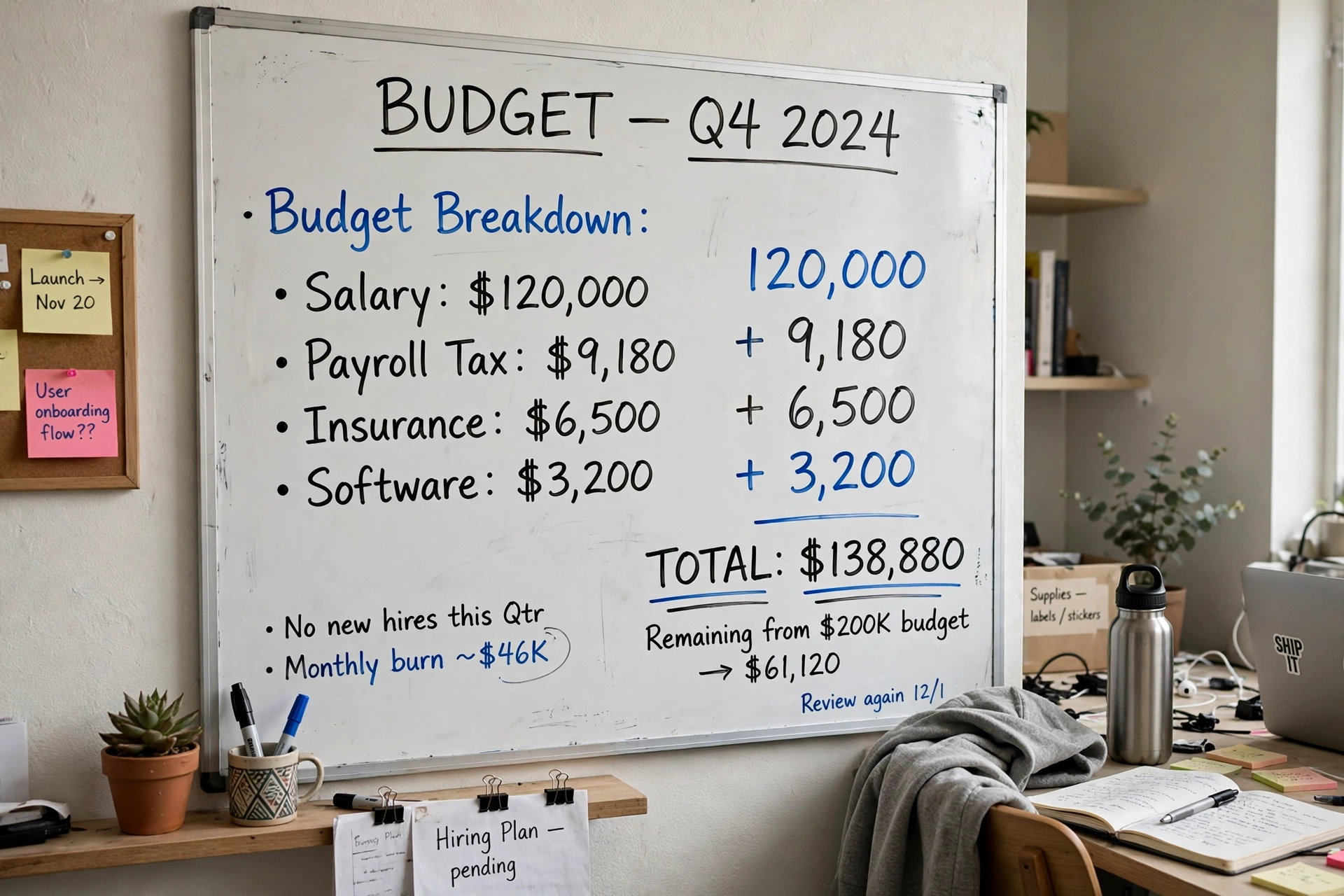
If your stated expenses include $8,000 a month of gross salaries counted at face value, the true cost is nearer $9,600 to $10,400. In the worked example below we use a conservative middle figure: a payroll load of $1,800 a month that never appeared in the founder’s $14,000.
This cost hides because it does not leave the bank as one labelled payment. It leaks out inside tax remittances, insurance premiums and benefits contributions that founders file under “admin” — or forget entirely when they build their expense list from offer-letter salaries. The money is gone either way.
Missed cost 2: annual and quarterly bills averaged away
Some of your largest bills do not arrive monthly. Business insurance is often paid once a year. So are many software renewals, professional memberships, accounting fees and quarterly estimated tax payments. A month containing none of them looks artificially cheap — and founders almost always pick a recent, clean month when they estimate burn.
The honest way to count these is to list every bill that arrives less often than monthly, total a full year of them, and divide by twelve. A business paying $3,600 a year for insurance, $2,400 in annual software renewals and $2,400 in quarterly tax-related payments has $8,400 a year of spending that barely shows in any single month: $700 a month of real burn hiding in the calendar.
In the worked example below, annual and quarterly bills add $700 a month to true expenses. For many businesses that figure is generous — one commercial insurance premium can exceed it on its own. The fix costs nothing: pull twelve months of statements, find every charge that appears once or four times instead of twelve, and average it in.
Missed cost 3: revenue that is booked but not yet collected
Revenue in a pitch deck and revenue in a bank account are two different things, and runway only respects the second one. If you invoice clients on thirty-day terms, a chunk of the revenue you “made” this month arrives next month — some of it arrives late, and a small slice never arrives at all. Add churn: customers who cancel take future monthly revenue with them, so the $8,000 you are projecting forward quietly becomes $7,500 or less.
Slow collections do not change what your revenue is on paper. They change the cash maths completely, because your expenses are paid in real time while your revenue lags behind them. In our example: of the $8,000 in monthly billings, only $7,500 a month is effectively available to offset burn once late payments and early churn are counted — a $500 a month gap. Businesses selling to large companies on 45- or 60-day terms routinely face a gap two or three times that size. The discipline is simple: count revenue when it clears, not when it is invoiced, and haircut it for the churn you already know is coming.
Missed cost 4: the “one-off” costs that keep coming back
Every founder’s expense list has a mental asterisk: legal fees were a one-off. The contractor was a one-off. The replacement laptops, the trademark filing, the emergency designer — all one-offs, all excluded from the “real” monthly number.
Look back over twelve months and add them up. In most businesses the one-offs form a stable monthly average of their own, because a growing company generates a steady stream of unusual-but-inevitable costs. There is always something; the names change, the total does not. So average the last year of them into your burn, like annual bills: a founder who spent $6,000 in a year on “exceptional” items has a $500 monthly cost wearing a disguise.
Missed cost 5: your own below-market salary
Many founders pay themselves far below what their role would cost to hire — sometimes nothing at all. That is a legitimate choice while bootstrapping, but it makes the runway maths lie in a dangerous way: the business only survives at its current burn because one essential employee is working at a steep, unsustainable discount.
Eventually that salary has to normalise: you may need a real wage to live, or have to hire your replacement at market rate. An investor doing diligence will normalise it for you, instantly shortening the runway they calculate. A business showing ten months of runway at a founder salary of $2,000 a month has far less at the $6,000 the role actually costs. Count it now, at the rate the business will realistically have to pay.
The worked example: 10.0 months becomes 6.7
Here is the same startup from earlier, calculated both ways, step by step.
The naive version
- Cash in bank: $60,000
- Monthly revenue (as billed): $8,000
- Monthly stated expenses: $14,000
- Net burn: $14,000 − $8,000 = $6,000
- Runway: $60,000 ÷ $6,000 = 10.0 months
The honest version
Start with the same stated expenses, then add the missed costs from this article:
- Stated expenses: $14,000
- Payroll taxes and benefits load on top of salaries: +$1,800 → $15,800
- Annual and quarterly bills, averaged monthly: +$700 → $16,500
- True monthly expenses: $16,500
Now fix the revenue side:
- Billed revenue: $8,000
- Slow collections and early churn: −$500
- Effective monthly revenue: $7,500
- True net burn: $16,500 − $7,500 = $9,000 a month
- True runway: $60,000 ÷ $9,000 = 6.67 months, or 6.7 months
Nothing about the business changed between those two calculations. Same cash, same customers, same team — the second version simply counts everything. Three and a third months of imaginary safety evaporated, because $3,000 a month of real cost and lost cash was sitting outside the headline number. And that is before any allowance for recurring one-offs or a normalised founder salary, either of which would shorten the honest runway further.
Run both versions on your own business. Enter your bank balance, collected revenue and stated expenses into the Burn Rate and Runway Calculator, note the runway, then re-run it with expenses rebuilt the honest way — payroll loaded, annual bills averaged in, revenue counted only when it clears. The gap between the two answers is the gap between your plan and your reality.
How to build an honest burn number
You do not need a finance team to fix this. You need one careful hour and twelve months of bank statements.
First, build expenses from a full year, not a month. Total everything that left the business in twelve months — payroll including taxes and benefits, annual premiums, quarterly payments, one-offs — and divide by twelve. That average is your gross burn, and it is almost always higher than the number you have been quoting.
Second, count revenue as cash collected, averaged over the same period, not invoices issued. Use money received, never money promised.
Third, list the corrections you are still not counting — your below-market salary, a committed hire, a supplier price increase — as a separate line under the calculation, so the next version includes them deliberately.
Fourth, recalculate monthly, right after the books close. One hire, one lost customer or one annual premium can move runway by a month; see it the week it happens.
How much runway is healthy?
Investors and experienced founders generally treat 12 to 18 months as the healthy range after a raise. It is long enough to hit the milestones that justify your next round, recover from one bad quarter, and run a full fundraising process without negotiating from desperation — and short enough that spending stays honest.
Between 6 and 12 months, you are in the planning zone: no emergency, but every significant hire or spend should be tested against the runway it consumes, and your fundraising or path-to-profit plan should already exist on paper.
Below 6 months is an emergency — for one mechanical reason covered below: raising money itself takes months, so at 6 months of runway you may already be too late to raise your way out.
What to do when the honest number is under 6 months
Cut in the right order. The goal is to reduce net burn fast without destroying the revenue that offsets it.
First, freeze everything discretionary today: new hires, new tools, travel, sponsorships, agencies on rolling contracts. This costs nothing in revenue and buys days immediately.
Second, renegotiate or cancel recurring costs in size order — the largest subscriptions, contracts and retainers first. A 20 percent cut on your biggest contract beats cancelling ten small tools, and it takes one conversation.
Third, pull revenue forward. Offer annual billing discounts to existing happy customers, tighten payment terms on new contracts, and chase every overdue invoice personally. Collected cash extends runway exactly as surely as cut costs do.
Fourth, address payroll — the biggest line — carefully and once. One clear, explained adjustment, starting with the founder’s own pay, lands better than repeated small cuts. Protect the people who directly produce and support revenue until the last possible step: cutting them cuts your collections too, and can shorten runway even as spending falls.
When to start fundraising
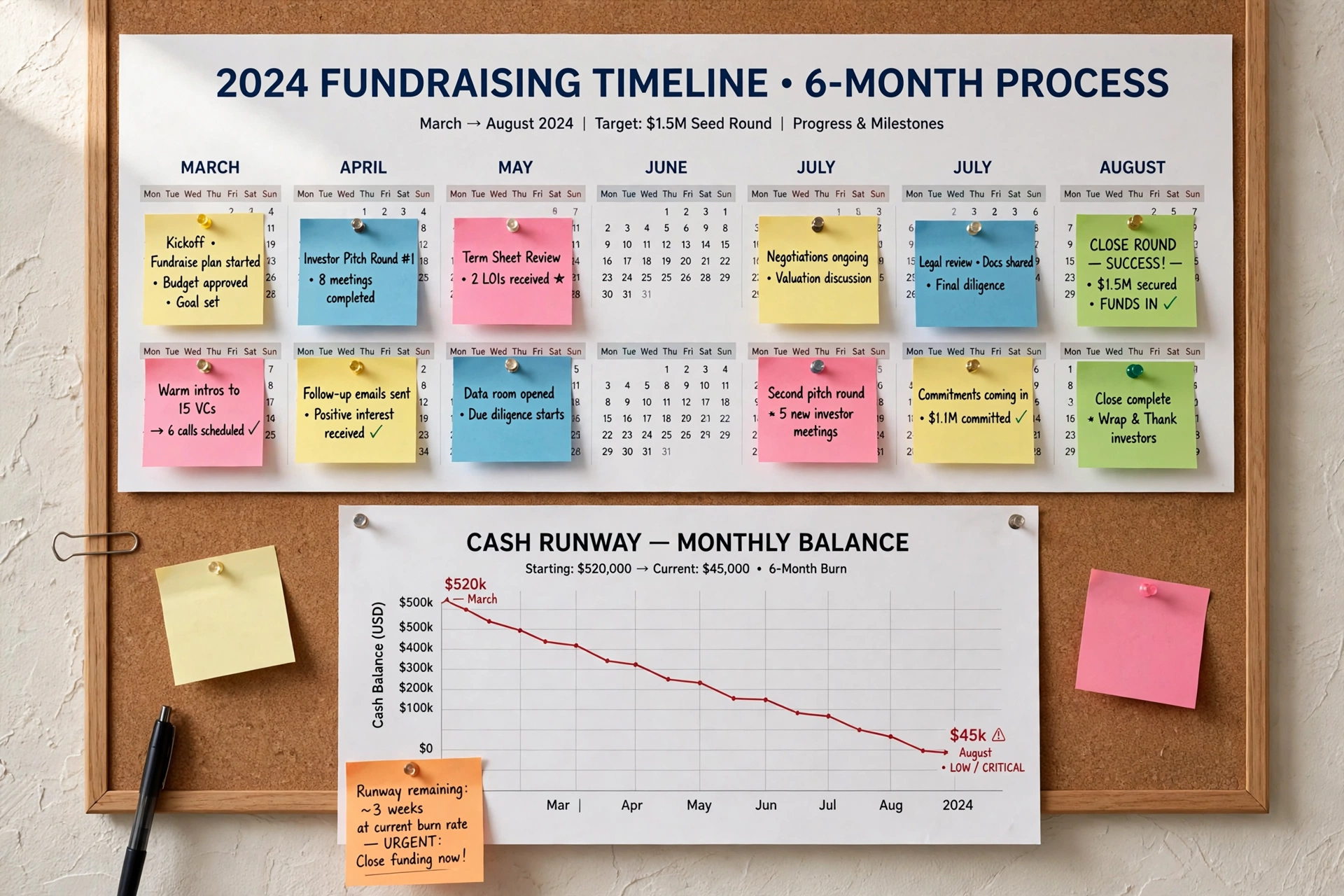
A typical seed raise takes three to six months from first serious conversations to money in the bank — often longer. That single fact should set your calendar. If a raise takes four months and you want to close it with at least three months of runway still in hand, you must start at roughly seven months of remaining runway at the latest — and starting at nine or ten months, while your numbers still show momentum, gets better terms and calmer conversations.
This is exactly why the naive calculation is so dangerous. The founder in our example believes they have 10.0 months and plans to start raising at month four or five. Their honest runway is 6.7 months. By their own schedule they would begin with under three months of cash left, run the process from visible desperation, and likely reach the end of the money before the end of the process. The company was not killed by its product or its market. It was killed by a division sum with the wrong inputs.
Frequently asked questions
Should I use gross burn or net burn to calculate runway?
Net burn, always — runway is about how fast your cash balance actually falls, and that is expenses minus collected revenue. Gross burn is still worth tracking: it shows your true cost base and the revenue you would need to break even.
How often should I recalculate my runway?
Monthly, on the same day each month, right after you close the previous month’s numbers — and immediately whenever something structural changes: a hire, a lost customer, a funding event, a major annual bill, or a change in your own salary. Runway from last quarter’s figures is history, not a planning tool.
Is it worth counting costs that only arrive once a year?
Yes — that is precisely the point. An annual insurance premium of $3,600 is a $300 monthly cost whether it leaves your account in one payment or twelve. Averaging infrequent bills into your monthly burn is the easiest correction most founders can make, and it commonly removes half a month to a full month of imaginary runway.
What if my revenue fluctuates a lot month to month?
Use a three-month or six-month average of cash actually collected, and run a pessimistic version using your worst recent month. Lumpy revenue is a reason to be more conservative, not less: expenses arrive evenly every month whether customers pay evenly or not, and the gap between the two is where businesses run out of money.