

Forming Your LLC in the Wrong State: The Double-Fee Trap
Every founder has seen the video. Form your LLC in Delaware, Wyoming or Nevada, it says, and you will save a fortune in taxes and fees. The home state where your business actually sits is presented as the sucker’s option — expensive, slow, best avoided by anyone smart enough to file somewhere cheaper.
Here is what the video leaves out: forming in another state does not remove your home state from your life. If your business operates in your home state — your office, your shop, your customers, your employees, you — your home state still requires you to register there, as a foreign LLC, and pay there too. You have not replaced one state’s bill with a cheaper one. You have signed up for both bills, two registered agents, two sets of annual filings, and two governments that can each fine you for missing theirs.
This is the double-fee trap, and it catches thousands of small businesses a year. This article explains the rule that creates it, walks through what the three famous states really cost in 2026 — the real figures surprise people in both directions — and shows when forming out of state genuinely makes sense, which for a local business is almost never.
The home-state rule: you pay where you operate
An LLC is not a federal creature. It exists because one state issued its formation documents, and it is a “domestic” LLC in exactly that one state. Everywhere else it does business, it is legally a foreign LLC — “foreign” simply meaning formed elsewhere — and nearly every state requires a foreign LLC doing business within its borders to register, usually by filing a certificate of authority or foreign registration statement, appointing a registered agent in that state, and paying a filing fee to do it.
What counts as doing business is not exotic. Having a physical location, employees, inventory, or regularly serving customers in a state qualifies in every ordinary case. If you run a coffee roastery, a trades business, an agency with a local office, or an online store operated from your home with stock in your garage, your home state is where you do business. There is no version of “but I formed in Wyoming” that changes where your kitchen table, your stock and your working day physically are.
Failing to foreign-register is not a clever saving. An unregistered foreign LLC can typically be fined and charged back-fees and penalties when it eventually registers — and most states bar it from suing in their courts until it does, so the business that skipped registration cannot enforce a contract or chase an unpaid invoice locally until it pays what it owed anyway. Banks, landlords and serious clients also ask for a certificate of good standing from the state where you operate, and that state will not issue one for a business it has no record of.
So the real comparison is never “Delaware versus my state.” It is “Delaware plus my state versus my state alone.” Run the comparison honestly and the famous states lose almost every time.
Myth-busting the famous three, with real 2026 numbers
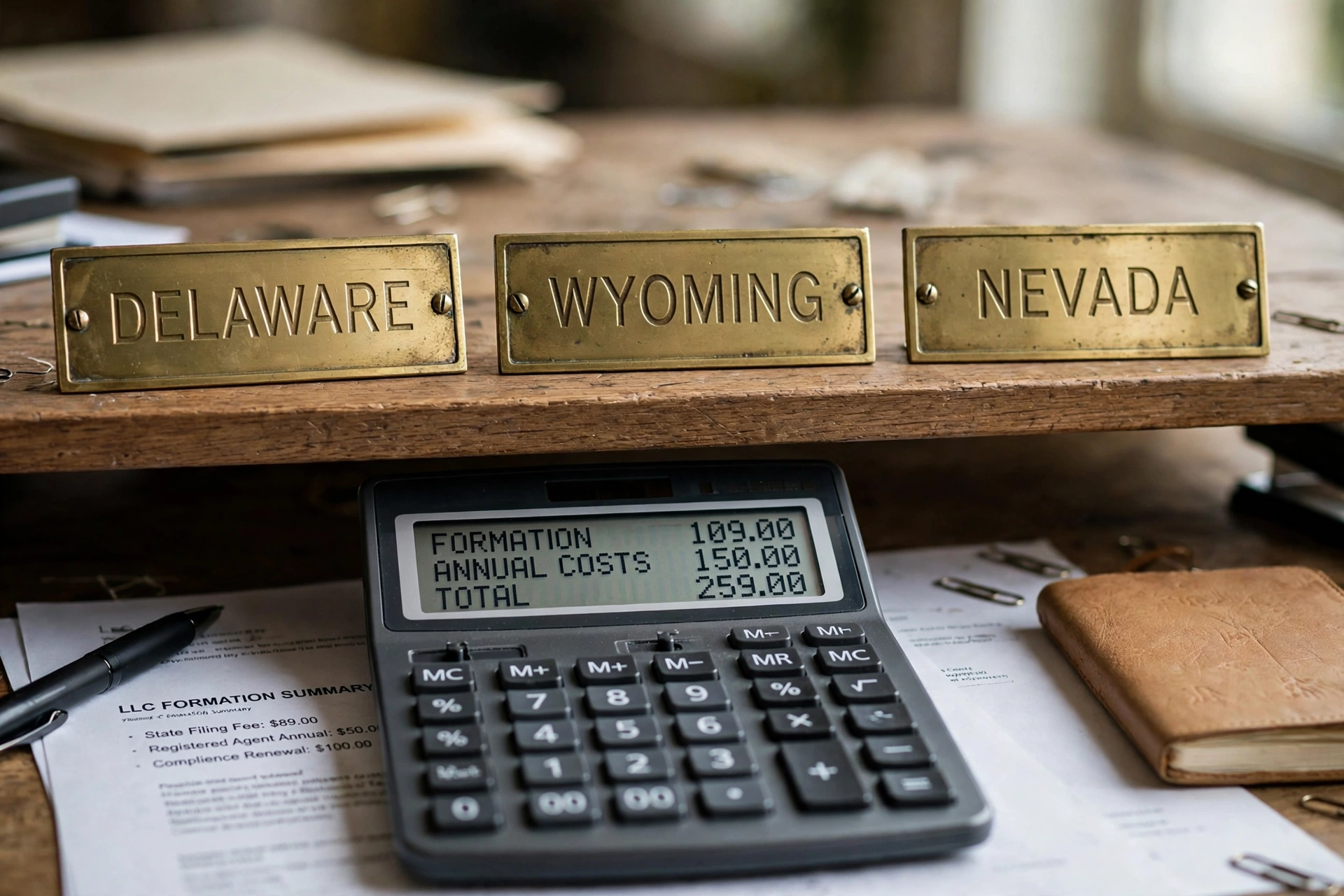
Delaware: the $300 fee that no longer exists
Delaware’s reputation rests on numbers that are no longer true — in both directions. The formation fee quoted in a thousand videos and articles is $300. As of August 1, 2026, Delaware’s Division of Corporations cut it: forming a Delaware LLC now costs $110. Anyone still quoting $300 is working from a stale schedule, and anyone who formed this year expecting to pay $300 got a pleasant surprise at checkout.
The other half of Delaware’s cost gets quoted far less. Delaware charges every LLC an annual tax of $400, due each June — not an annual report fee, a flat tax, the same for a one-person LLC as for a much larger one. There is no cheaper year and no small-business tier. So Delaware’s real first-year state cost is $110 to form plus $400 in annual tax: $510. Over three years, $110 plus three years of $400 tax is $1,310 — paid to Delaware alone, before your home state has charged you a cent.
Delaware’s genuine advantages — its Court of Chancery, its deep case law, investors’ familiarity with its entities — serve corporations raising venture capital, discussed below. For an LLC running a local business, they buy you almost nothing you can use, at $400 a year.
Wyoming: cheap is real, and still not free of your home state
Wyoming is the one famous state where the “cheap” pitch starts from a true place. Formation costs $100, and the annual license tax is the greater of $60 or a small fraction of your Wyoming assets — so $60 a year for most small LLCs. First-year total to Wyoming: $160. Three years: $280. Those are genuinely low numbers, and Wyoming adds real privacy features that some owners value.
But notice what the pitch quietly assumes: that the Wyoming bill replaces your home-state bill. It does not. The moment your business operates from, say, California, California requires foreign registration and — this is the expensive part — California’s $800 annual franchise tax applies to LLCs doing business in California regardless of where they were formed. Forming in Wyoming does not move your California tax bill to Wyoming. It leaves the California bill exactly where it was and adds Wyoming’s bill on top.
Nevada: the $75 fee that is actually $425
Nevada is the trap in its purest form, because its headline number is the most misleading of the three. The Articles of Organization cost $75, and that is the figure the pitch leads with. But Nevada does not let you stop at the Articles. At formation you must also file an Initial List of managers or members, at $150, and buy a State Business License, at $200. The mandatory total on day one is $75 plus $150 plus $200 — $425 — the second-highest formation cost in the country, behind only Massachusetts. After that, the list and the license renew for $350 every year.
A founder who chose Nevada believing it cost $75 has committed to $425 up front and $350 a year, in exchange for avoiding a home-state filing fee that in most states is between $50 and $150 once, with far smaller annual costs. It is the single most expensive version of this mistake.
The double-fee trap, worked in real dollars
Put it together with a concrete founder. A roaster runs her business from California — equipment, stock, customers and her own working day all in California. She forms in Wyoming because a video said it was cheap, and she keeps her paperwork there perfectly.
Her Wyoming costs: $100 to form, plus $60 a year in license tax. First year, $160.
Her California costs, which did not move: she must foreign-register the Wyoming LLC in California, paying a further state filing fee to do so, appoint and pay a registered agent in California as well as the one she now needs in Wyoming, and pay California’s $800 annual franchise tax, because that tax follows the business activity, not the formation paperwork. First year in California: at least $800, plus the registration fee and the second agent.
Total first-year state cost: at least $960, before either registered agent’s commercial fee, and she now files in two states forever. Forming in California in the first place would have cost a $70 filing fee plus the same $800 franchise tax — $870 — with one agent, one state, one set of deadlines. The “cheap” route costs more in year one and keeps costing more every year after, because the Wyoming $60 and the dual-agent and dual-filing overhead never stop. Multiply the pattern across a Delaware formation instead — $510 to Delaware in year one, plus the same home-state bill — and the leak becomes a flood.
The trap has the same shape in cheaper home states, only the numbers shrink. A Kentucky business that forms in Delaware pays Delaware’s $110 and $400 a year, plus Kentucky’s foreign registration and Kentucky’s costs, to avoid a home formation fee of $40 with a $15 annual report. Forty dollars, once, was the entire prize.

When forming out of state genuinely makes sense
Almost never — for an operating local business. But “almost” is doing real work in that sentence, and the exceptions are worth naming precisely so they stop being used as cover for the general mistake.
You actually operate in that state. If your business’s real base — premises, staff, activity — is in Wyoming, forming in Wyoming is not out-of-state formation at all. It is home formation. The rule is about where you operate, not about which state is fashionable.
You are a venture-backed startup, and usually a corporation, not an LLC. Delaware’s real advantage is its corporate law and court system, and it matters to startups raising institutional venture capital, whose investors routinely require a Delaware C-corporation. That is a specific, well-founded convention in one industry. It says nothing about LLCs, nothing about local businesses, and nothing about taxes — a Delaware corporation operating in another state foreign-registers and pays there too.
You hold property or operate in several states from day one. A business genuinely launching across state lines registers in several states anyway, and choosing the formation state among them can be a real, if minor, optimisation. This describes a small minority of new businesses — and even they pay every state they operate in.
What never appears on the list: tax avoidance for a local business. State taxes generally follow the activity — where the work is done, where the customers are, where the property sits. A formation certificate from a low-tax state does not relocate any of that, and acting as though it does creates the worst outcome here: not just double fees, but an unfiled home-state position that surfaces years later with penalties attached.
The cheapest correct answer: form at home
Strip the myth away and home-state formation is, for most founders, both the legal requirement and the bargain. Filing fees are mostly modest. Montana is the cheapest at $35. Kentucky charges $40. A large group of states sit at $50 — Arizona, Colorado, Hawaii, Iowa, Michigan, Mississippi, Missouri and New Mexico among them — and most of the rest fall between there and $150. California’s filing fee is just $70, though its $800 annual franchise tax makes its ongoing cost high regardless of where you form. The most expensive formation in America is Massachusetts, at $500 on paper or $520 filed online, with the same again due every year — a real cost, and still cheaper than Massachusetts as your home state plus a famous state on top.
Annual costs at home are usually as modest: $15 in Kentucky, no annual report fee at all in states like Arizona, Ohio, Missouri and New Mexico, mid-range figures elsewhere. Every one of those numbers beats the double-state alternative.
Before you file anywhere, run the honest comparison for your own situation: your home state’s full cost, side by side with the famous state’s cost plus your home state’s foreign-registration cost stacked on top. Our LLC Formation Cost Calculator holds the current filing fee, mandatory extras and annual charges for all 50 states and DC, so you can price both routes with the real 2026 figures instead of a video’s. Founders who do that arithmetic once rarely need convincing twice.
The bottom line
The state you form in is not a loophole; it is a mailing address for your paperwork. Your obligations live where your business lives. Forming in Delaware, Wyoming or Nevada while operating somewhere else does not delete your home state’s bill — it adds a second one, with its own agent, its own annual filings and its own penalties, in exchange for avoiding a home filing fee that usually costs less than the famous state’s annual charges alone. Form at home, pay one state, keep the paperwork simple, and spend the money you saved on the business itself.
Frequently asked questions
If I form in Wyoming, do I still have to register in my home state?
In almost every ordinary case, yes. If your business has a physical presence, employees, inventory or regular customer-facing activity in your home state, that state treats your Wyoming LLC as a foreign LLC doing business there and requires foreign registration, a registered agent in the state, and payment of its fees and any taxes that apply to the activity. Skipping it risks fines, back-fees, and being unable to enforce contracts in that state’s courts until you register.
Is Delaware still worth it after its 2026 fee cut?
The cut made Delaware cheaper to enter — $110 to form, down from $300 on August 1, 2026 — but the $400 annual tax is unchanged, so Delaware still costs $510 in its first year and $400 every year after, before your home state’s charges. For venture-backed corporations raising institutional money, Delaware’s legal system can justify its costs. For a local LLC, the arithmetic rarely works.
Why does Nevada advertise a $75 LLC if it really costs $425?
Because $75 is the price of one document — the Articles of Organization — quoted on its own. Nevada also requires an Initial List ($150) and a State Business License ($200) at formation, so the mandatory total is $425, and the list and license together renew at $350 a year. The $75 figure is accurate and incomplete in exactly the way that makes the double-fee trap work.
What is the cheapest state to form an LLC in?
Montana, at a $35 filing fee, followed by Kentucky at $40. But the right question is what your home state costs, because that bill exists either way. Most states charge between $50 and $150 to form, with low or zero annual report fees — which is why forming at home is almost always the cheapest legal option once foreign registration in your home state is counted.