How Much Does It Cost to Open a Franchise in 2026?
For anyone asking how much does it cost to open a franchise, the typical answer is $224,000 to $483,000 all-in, with a typical franchise fee of $40,000. That range covers the fee, the build-out, the equipment, and the cash needed to run the business until sales build, while about 12% of brands cost $100,000 or less to open.
The spread is wide: about 12% of brands cost $100,000 or less to open, and about 17% cost more than $1 million. This guide breaks the total into four layers, shows the cost by format and industry, and explains how to read the Franchise Disclosure Document, or FDD, and its Item 7 table. All figures here are benchmarks from FDD Item 7 tables, not quotes for any specific brand.
Start With the FDD Item 7 Table
Before you fall in love with a brand, ask for its Franchise Disclosure Document. The FDD is the disclosure document a franchisor must give you at least 14 days before you sign anything, under the FTC Franchise Rule. It replaces sales talk with the franchisor’s own written estimates.
Item 7 lists the franchisor’s estimated initial investment, broken into line items: the franchise fee, rent and deposits, leasehold improvements, equipment, signage, opening inventory, insurance, licences, training, and additional funds for the first few months. Each line shows a low and a high estimate. Items 5 and 6 list the initial and ongoing fees, including the royalty and the brand or marketing fund contribution. Read Items 5, 6, and 7 together and you have the full cost picture in the franchisor’s own words.
One caution matters. FDD figures describe existing units, not a projection for a new one, and your actual costs will depend on your location and the space you lease. Treat Item 7 as a benchmark, not a promise.
The Four Layers of Franchise Cost
Most buyers think of franchise cost as one number. In practice it has four layers, and each behaves differently.
| Cost layer | What it covers | When you pay it |
|---|---|---|
| 1. Franchise fee | The right to use the brand, its systems, training and opening support | Once, before you sign and open |
| 2. Startup and build-out | Lease deposits, construction, equipment, signage, opening inventory, licences and insurance | Once, before opening day |
| 3. Working capital | Cash for payroll, rent and supplies for the first few months while sales build | Before and just after opening |
| 4. Ongoing royalties and fees | Royalty on gross sales plus brand and marketing fund contributions | Every month, for as long as you operate |
The first two layers are the ones most people budget for. The third catches people out: most estimates include “additional funds” for payroll, rent and supplies in the first few months. The fourth layer never stops, because royalties come out of gross sales every month. Judge a franchise on all four layers, not on the opening number alone.

How Much Does It Cost to Open a Franchise?
A typical franchise costs $224,000 to $483,000 to open, according to Franchise Tally, updated November 20, 2026. That figure is the total initial investment for a typical brand, including the franchise fee, the build-out, the equipment, and the additional funds needed for the first months.
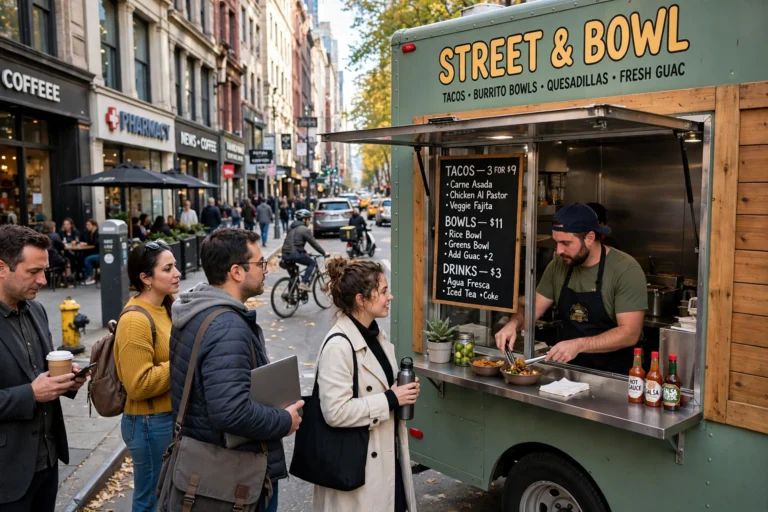
About 12% of brands cost $100,000 or less to open, usually home-based or mobile concepts with no retail lease. About 17% cost more than $1 million, usually large restaurants and hotels that need a big site and a large staff. If the brand you are looking at sits far outside the typical band, ask what drives the difference.
What Is the Franchise Fee?
The franchise fee is the one-time payment you make to the franchisor for the right to use its brand, its operating system, its training, and its opening support. It is typically $20,000 to $50,000, or $40,000 to $60,000 for established brands, and the typical fee across the market is $40,000.
The fee is part of the total, not on top of it. If a brand’s total initial investment is $224,000 to $483,000 and its franchise fee is $40,000, the fee is already inside that total. It usually accounts for about 5 to 10% of the total investment, or around 17% of the low-end estimate where the total is at its smallest. In most systems the fee covers the licence to trade under the brand name, the operations manual, initial training, and opening support. It does not cover the physical business: the lease, the fit-out, the equipment, the stock, and the wages. Most franchisors expect the fee in full before training begins.
Total Investment by Format
Format is the biggest single driver of cost. A franchise that operates from your home has no lease and no shop fit-out. A franchise that needs a drive-thru, a kitchen, and a dining room has all three.
| Format | Total investment |
|---|---|
| Home-based service | $45,000–$120,000 |
| Van or mobile | $90,000–$220,000 |
| Retail kiosk | $130,000–$300,000 |
| Fitness studio | $250,000–$600,000 |
| Fast-casual restaurant | $400,000–$1.1M |
| Full-service restaurant | $500,000+ |
| QSR with drive-thru | $900,000–$2.5M |
A home-based service franchise, at $45,000 to $120,000, is the lowest-cost way into franchising. A van or mobile franchise costs $90,000 to $220,000, a retail kiosk $130,000 to $300,000, and a fitness studio $250,000 to $600,000. Fast-casual runs $400,000 to $1.1 million, full-service $500,000 or more, and a drive-thru QSR $900,000 to $2.5 million.
Two brand examples show the food range. Subway’s franchisor estimates put the total at $263,000 to $630,000; McDonald’s put it at $1.47 million to $2.81 million. Format explains more of the cost than the industry label does.
Cost by Industry
Industry matters too, though less than format. A travel agency franchise typically costs $12,000 to $21,000 to open, making it the cheapest industry in this comparison. Insurance typically costs $55,000 to $113,000, tax preparation $58,000 to $97,000, business services $77,000 to $137,000, and home service $119,000 to $209,000. Food typically costs $351,000 to $753,000, restaurants $406,000 to $868,000, and hotels $9.4 million to $23.5 million.
Service businesses that need little more than a desk, a phone, and a laptop sit at the low end; businesses that need a kitchen or a building sit at the high end. If your budget is fixed, the industry you choose may matter more than the brand, because it sets the floor for what any brand in that industry will cost.
How Much Money Do You Need to Open a Franchise?
You typically need liquid capital of 20 to 30% of the total investment. Liquid capital is the cash and other assets you can access quickly, and franchisors check it because they want to know you can survive the opening period without running out of money.
On a typical franchise costing $224,000 to $483,000, that means roughly $45,000 to $145,000 in liquid capital. The franchisor states its own minimum in the FDD, and some brands set the bar higher. Meeting it is not a formality: it checks that you can pay the fee, fund the build-out, and still have cash left for payroll and rent.
Lenders commonly expect 10 to 30% of the total from your own money, with the rest borrowed, often through an SBA-backed bank loan. Franchise buyers often finance with an SBA 7(a) loan, which typically involves a 10% equity injection. You do not need the full total in cash, but you do need a meaningful share of it.

Ongoing Fees: Royalties and the Marketing Fund
The opening cost is only half the financial story. Once the doors open, you pay the franchisor every month for as long as you operate. The royalty is typically 6% of gross sales, with a range of 4 to 12%. On top of that, you typically pay about 2% of gross sales into a brand or marketing fund, with a range of 1 to 3%. Combined, ongoing fees commonly run 6 to 12% of gross sales.
That percentage comes off the top, before rent, wages, and supplies. On $50,000 of monthly gross sales, a 6% royalty is $3,000 a month and a 2% marketing contribution is another $1,000 — $48,000 over a year. Ask what the marketing fund actually buys, and check Item 6 for other ongoing charges, such as a technology fee or required purchases from an approved vendor.
Working Capital: The Cost People Forget
Working capital is the cash that keeps the business running between opening day and the day sales cover the bills. Most estimates include “additional funds” for this purpose, and the Item 7 table lists it as a line item. It covers payroll, rent, and supplies for the first few months while sales build, and it is the layer most new owners underestimate.
A new business rarely trades at full speed from day one, yet rent, wages, and suppliers still need paying. The additional funds line is the franchisor’s estimate of what you need to bridge that gap. Treat it as a minimum, and ask how many months of fixed costs you can cover without any sales at all. If the answer is less than three months, your working capital is thin.
The legal and banking side has its own costs, outside the franchise fee. Learning how much a business bank account costs helps you budget the monthly banking fees, and checking how much a business license costs helps you price the permits your location will need. Both belong in your opening budget rather than discovered after you have signed.
Are Franchises Profitable?
A franchise can be profitable, but profitability depends on the brand, the location, the owner’s management, and the ongoing fees — not on the franchise model alone. There is no single profit figure for franchising, and any franchisor that promises one should be treated with caution.
The FDD contains a section, Item 19, where some franchisors publish financial performance representations. Not every franchisor provides one. If the brand you are considering publishes an Item 19, read it carefully, and note whether it shows profit or only sales. Sales without costs tell you nothing about profit. If the brand does not publish an Item 19, the franchisor is not allowed to give you earnings claims in conversation either, so be wary of verbal promises that do not appear in the document.
Judge profitability from the unit economics. Take the royalty and marketing fund together, at commonly 6 to 12% of gross sales, and subtract them from gross sales along with rent, wages, and cost of goods. What is left is the owner’s return, before tax and loan repayments. Then ask how long that return takes to repay the opening investment, and ask existing franchisees how long it took them to reach break-even.
Choosing Between a Cheap Franchise and an Expensive One
A low-cost franchise is not automatically a bargain, and a high-cost franchise is not automatically a better business. Compare brands inside the same format and industry, not across them: the total investment, the royalty and marketing rates, the Item 19 data if available, and the support the franchisor provides. Then ask franchisees what the opening actually cost them, compared with the Item 7 estimate.
Also think about the legal structure of your business before you sign. Reading a clear comparison of DBA vs LLC and which one you need can save you a costly restructure later. And if you are weighing a home service franchise against an independent start, it helps to know how much it costs to start a cleaning business on its own, so you can judge what the fee and royalty actually buy you.

A Practical Checklist Before You Sign
First, read the FDD in full, including the Item 7 total, the Item 5 and 6 fees, and the renewal and transfer terms. Second, talk to at least five current franchisees and two who have left about the real opening cost and the time to break-even. Third, build your own six-month budget, including working capital. Fourth, confirm your financing in writing. Fifth, have a franchise lawyer review the agreement and the FDD before you sign anything. If any step raises a problem you cannot resolve, pause.
How much does it cost to open a franchise?
A typical franchise costs $224,000 to $483,000 to open, according to Franchise Tally, updated November 20, 2026. About 12% of brands cost $100,000 or less, and about 17% cost more than $1 million, so the format and industry you choose set the real range.
What is the franchise fee, and is it separate from the total?
The franchise fee is typically $20,000 to $50,000, or $40,000 to $60,000 for established brands, with a typical fee of $40,000. No, it is not separate from the total: the fee is part of the total initial investment, usually about 5 to 10% of it, and it covers the licence to use the brand, its systems, training and opening support.
What is FDD Item 7?
FDD Item 7 is the section of the Franchise Disclosure Document that lists the franchisor’s estimated initial investment, broken into line items from the franchise fee to additional funds for the first few months. Franchisors must give you the FDD at least 14 days before signing, under the FTC Franchise Rule, and Item 7 figures describe existing units rather than projecting a new one.
How much cash do I need upfront to open a franchise?
You typically need liquid capital of 20 to 30% of the total investment, and lenders commonly expect 10 to 30% of the total from your own money, with the rest borrowed, often through an SBA-backed bank loan. Franchise buyers often finance with an SBA 7(a) loan, which typically involves a 10% equity injection.
Source: Franchise Tally, updated November 20, 2026; FTC Franchise Rule. All figures are benchmarks from FDD Item 7 tables, not quotes for any specific brand.