
How Much Does a Business Phone System Cost in 2026?
A business phone system costs $15 to $25 per user per month for a small business when you pay annually. A 3-person team pays roughly $45 to $60 a month before taxes and fees, and a 10-person team pays roughly $150 to $200. The cheapest options are flat-rate virtual systems, which start at $25 a month for the whole team.
Prices are the providers’ own published prices, checked 19 November 2026, in US dollars and before tax.
The short answer
Most small businesses land on a cloud phone system, usually called VoIP, at $15 to $25 per user per month on annual billing. That is the plan price — the invoice runs higher, because every provider adds taxes and regulatory fees, so budget roughly 15 to 25 percent extra. The cheapest route to a business number is a virtual system such as Grasshopper: a flat $25 a month for the whole account, though it lacks call queues, recording and integrations. A traditional on-premise system still costs $35 to $70 per line per month plus $5,000 to $20,000 upfront.
The three kinds of business phone system
Cloud VoIP (hosted phone system). Calls travel over the internet, not copper wires. There is no box in your office to buy or maintain, pricing is per user per month, and your team can answer from a desk phone, laptop or mobile app. Typical cost: $10 to $40 per user per month, most small businesses landing around $20.
Virtual phone system. A business number on top of your existing mobile phones, with a professional greeting, extensions and voicemail, and calls forwarded to whoever is on duty. No desk phones, no per-user charge — Grasshopper charges per account, from $14 a month. Best for solo owners and very small teams who take calls on their mobiles.
On-premise PBX (landline system). A physical system installed in your office, connected to traditional phone lines: $30 to $60 per line per month plus $200 to $1,000 or more per handset, with installation running into thousands. Over five years, cloud VoIP costs 37 to 41 percent less, according to independent cost analysis.
The providers, side by side
| Provider | Entry plan (annual / monthly) | Mid plan (annual / monthly) | Key limits on the entry plan |
|---|---|---|---|
| RingCentral RingEX | Core $20 / $30 | Advanced $25 / $35 | 100 toll-free min, 25 texts/user/mo |
| Nextiva | Core $15 / $23 | Engage $25 / $50 | 100 texts/user/mo; toll-free is an add-on |
| Dialpad Connect | Standard $15 / $27 | Pro $25 / $35 | No CRM integrations; 250 texts/account/mo |
| Zoom Phone | Metered $10.50 / $12 | Unlimited $16 / $18 | Metered: ~3 cents/min outbound |
| Ooma Office | Essentials $19.95 | Pro $24.95 | No texting, desktop app or recording |
| Vonage VBC | Mobile $13.99 promo / $19.99 | Premium $20.99 promo / $29.99 | 12-month promo; +43% at renewal |
| Grasshopper | True Solo $14 / $18 | Solo Plus $25 / $32 | Flat rate; 1 number, 3 extensions |
Zoom Phone’s $10.50 entry price is the metered plan: every outbound call costs about 3 cents a minute on top. Below about 183 outbound minutes a month, metered wins; above that, take the $16 unlimited plan. Ooma is the only provider with no annual discount — Essentials is $19.95 either way, with no contract — which beats Nextiva’s $23 month-to-month price but not its $15 annual price.
Vonage needs the most careful reading. Its $13.99, $20.99 and $27.99 rates are 12-month promotions; after year one the same plans cost $19.99, $29.99 and $39.99. Per-line prices also fall as your team grows — Premium drops to $27.99 on 5 to 19 lines.
Grasshopper is the odd one out, and the cheapest for a team: Solo Plus costs $25 a month flat for unlimited users, one number and three extensions. But it is a virtual system — no call queue, CRM integration or video meetings — and it only works in the US and Canada.

How much does a small business phone system cost per month? Two worked examples
Totals below are on annual billing at the entry plan, before taxes and fees.
A 3-person team, entry plans, before taxes and fees:
| Provider | Plan | Monthly total |
|---|---|---|
| Grasshopper | Solo Plus (flat rate) | $25 |
| Vonage | Mobile, promo rate | $41.97 |
| Nextiva | Core | $45 |
| Dialpad | Standard | $45 |
| Zoom Phone | Unlimited | $48 |
| Ooma Office | Essentials | $59.85 |
| RingCentral | Core | $60 |
A 10-person team, entry plans, before taxes and fees:
| Provider | Plan | Monthly total |
|---|---|---|
| Grasshopper | Small Business (flat rate) | $55 |
| Nextiva | Core | $150 |
| Dialpad | Standard | $150 |
| Zoom Phone | Unlimited | $160 |
| Ooma Office | Essentials | $199.50 |
| RingCentral | Core | $200 |
| Vonage | Premium, promo rate | $209.90 |
The gap between the cheapest and the most expensive full system is about $50 a month for a 3-person team and about $60 for a 10-person team. Grasshopper breaks the pattern: $25 a month for 3 people and $55 for 10, because it charges by the account.
Taxes and regulatory fees typically add 15 to 25 percent. On Nextiva Core, the 3-person $45 becomes roughly $52 to $56 a month, and the 10-person $150 becomes roughly $173 to $188. Vonage lists a $3.50 recovery fee per extension plus 911 charges; Nextiva charges about $3.50 a line plus about $1.50 for E911.
What drives the price up — and down
Billing term. Annual billing is the single biggest saving. RingCentral Core drops from $30 to $20 a user a month, Dialpad Standard from $27 to $15, and Nextiva Engage from $50 to $25. A 10-person team on RingCentral Core saves $1,200 a year by paying annually. The catch is the 12-month term, and some providers do not refund the remaining months if you cancel. Pay monthly while you test the service, then switch to annual.
Tier. The jump from entry to mid-tier costs $5 to $10 per user a month, and it buys the features small businesses usually end up wanting: call recording, CRM integrations, more toll-free minutes and more texts. Recording is the classic example: an add-on on Nextiva Core and Ooma Essentials, but included on Dialpad Standard and RingCentral Advanced. If you need it, compare mid-tier prices.
Headcount. Per-user pricing means every hire adds $15 to $25 a month. A team growing from 5 to 10 people doubles its phone bill. Flat-rate virtual systems are the exception: Grasshopper’s $25 Solo Plus does not change when you add a fourth or fifth person. Dialpad Pro has the opposite quirk — a three-user minimum, so a two-person business pays for a seat it does not use.
Bundling. The mid and top tiers of RingCentral, Zoom Phone and Nextiva bundle video meetings, team chat and SMS with the phone service. If your team pays separately for a phone system, a video tool and a chat app, consolidating can cut the combined bill — price the stack, not just the phone line. how much Slack costs per user is a useful comparison if chat is one of the tools you would replace, and Microsoft 365 vs Google Workspace matters the same way: if you already pay for Microsoft 365, Teams Phone may be cheaper than a standalone system.
Hidden fees: where the bill grows
Taxes and regulatory fees. Every provider adds federal and state taxes, a universal service recovery fee and an E911 fee — expect 15 to 25 percent on top of the subscription. RingCentral lists its recovery, E911 and compliance fees without printing the rates.
Toll-free minutes. Every plan includes a toll-free allowance and charges for going over it. RingCentral Core includes 100 pooled toll-free minutes a month; Advanced includes 1,000 and Ultra 10,000. Nextiva Core includes no toll-free minutes at all — the number itself is an add-on — while Engage includes up to 2,000.
Texting limits. SMS is capped on most entry plans: 25 messages per user a month on RingCentral Core, 100 on Nextiva Core, 250 per account on Dialpad Standard, none on Ooma Essentials. Grasshopper also needs a one-time $19 texting registration plus about $1.50 a month in compliance fees.
Setup and number porting. Moving your existing business number to a new provider is usually free — Nextiva includes it, and most cloud providers do. Porting a number still under contract with your old provider can cost money. Ooma charges a one-time $29.95 activation fee.
Add-ons. The AI features are the new upsell. RingCentral’s AI Receptionist costs $39 a month for 100 minutes, then 50 cents a minute. Nextiva’s AI receptionist, XBert, costs $99 a month for 100 conversations. These are extras, not part of the plan price. For a very small team, how much a virtual assistant costs is worth comparing — a part-time human answering calls can cost less than an AI add-on plus a phone plan.
Hardware: desk phones and headsets
A cloud phone system needs no hardware — your team can take calls on laptops and mobiles through an app. But many offices still want desk phones: a basic VoIP handset costs $60 to $300, a usable mid-range one about $100 to $150, and a conference phone $647 to $1,330. Headsets run $30 to $100 each.
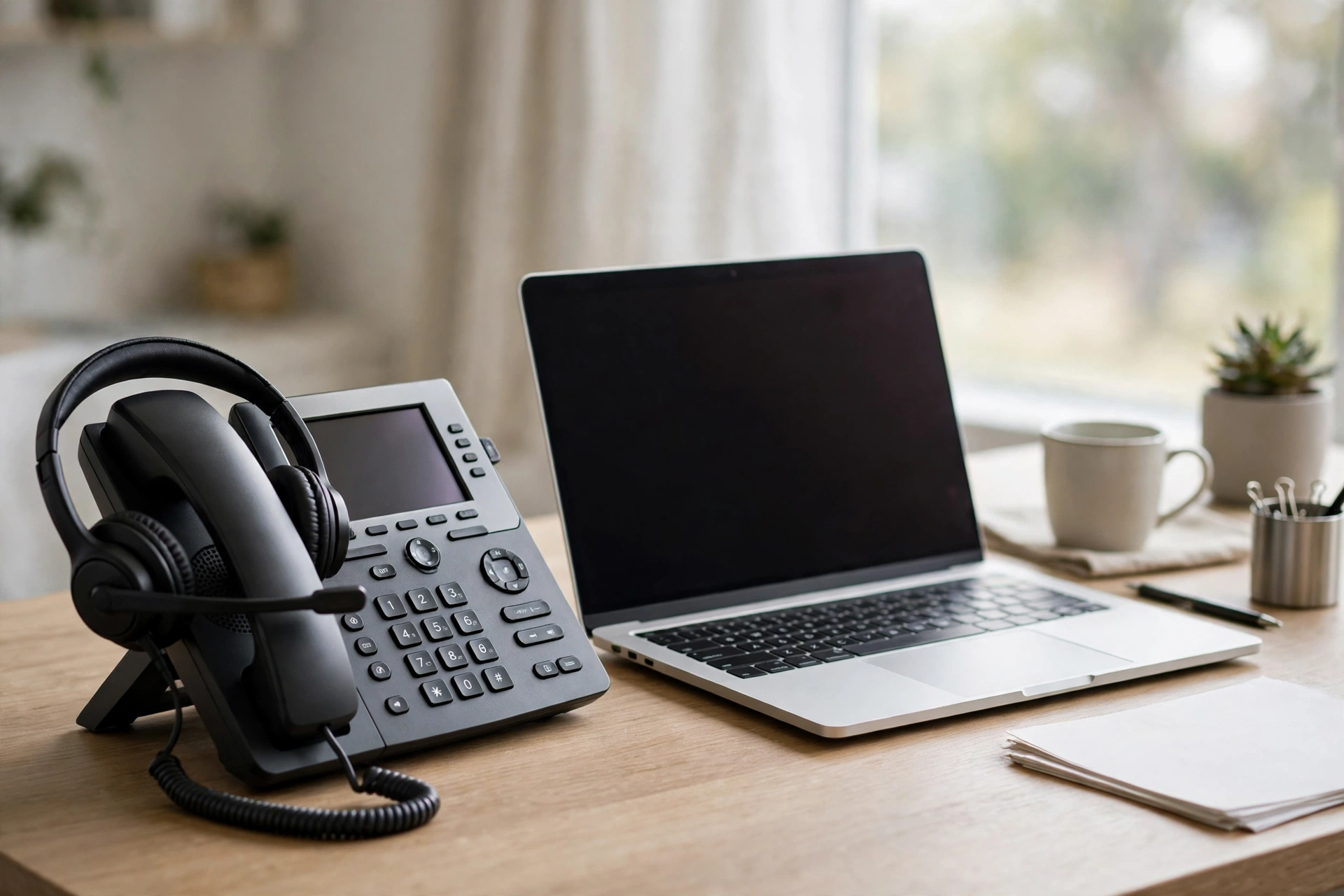
A 10-person office buying a $100 desk phone per person spends $1,000 upfront — roughly five months of service on an entry plan. Some providers rent phones at about $3 to $7 per device per month instead, which spreads the cost but adds a permanent line to the bill. Before buying, check which phones your provider supports: a phone bought for one system may not work on another. For a distributed team there is no hardware question at all — a cloud system plus headsets is enough, which is one reason cloud phones suit managing a remote team across time zones.
How to choose without overpaying
Solo owner or a team of two or three who mainly need a professional number and a greeting: start with a virtual system. Grasshopper Solo Plus at $25 a month flat covers unlimited users; True Solo at $14 covers one person. Upgrade only when you need call queues, recording or CRM integration.
A team of 3 to 10 that lives on the phone: take the entry plan of a full cloud system on annual billing. Nextiva Core and Dialpad Standard at $15 a user a month are the cheapest entry points, Zoom Phone Unlimited at $16 is the best value for heavy outbound calling, and RingCentral Core at $20 is the most complete entry plan. Pay monthly while you test call quality, then switch to annual.
If you need call recording, CRM integration or a call queue, compare mid-tier prices, not entry prices. Dialpad Pro, RingCentral Advanced and Nextiva Engage all cost $25 on annual billing — pick on features and on the CRM you already use.
If you already use Zoom or Microsoft 365 every day, check the bundled option first. Zoom Phone’s Pro Plus and Business Plus bundles combine meetings and calling from $20.50 a user a month, and Teams Phone builds on a Microsoft 365 subscription you may already pay for — the cheapest phone system is often the one folded into a tool you already own.
Whatever you choose, get three things in writing before you sign: the all-in monthly total, the renewal price after any promotion ends, and the cancellation terms. Vonage’s 43 percent renewal jump is the cautionary tale — a promotion is only a saving if you know what year two costs.
The bottom line
A business phone system costs $15 to $25 per user per month in 2026 on annual billing, or $25 a month flat for the whole team on a virtual system such as Grasshopper. Budget $45 to $60 a month for a 3-person team and $150 to $200 for a 10-person team, before taxes and fees, then add 15 to 25 percent. The provider matters less than the tier and the billing term: annual billing saves up to a third, and the mid-tier plan is usually where the features a growing business needs live. Start on the entry plan, test it for a month, then commit to a year.
Frequently asked questions
How much does a small business phone system cost per month?
A small business phone system costs $15 to $25 per user per month on annual billing, or $25 a month flat for the whole team on a virtual system such as Grasshopper. A 3-person team pays roughly $45 to $60 a month before taxes and fees, and a 10-person team pays roughly $150 to $200, plus 15 to 25 percent in taxes and regulatory fees.
What is the average cost of a VoIP phone system for a small business?
The average small business pays around $20 per user per month for a cloud VoIP phone system. Most plans fall between $10 and $40: entry $10 to $20, mid-tier with recording and CRM integrations $20 to $30, and advanced with AI features and analytics $30 to $40 or more.
What is the cheapest business phone system for a small business?
The cheapest business phone system is a flat-rate virtual system: Grasshopper Solo Plus costs $25 a month for the whole team, with unlimited users. For a full cloud phone system, the cheapest entry is Zoom Phone Metered at $10.50 per user per month, or Nextiva Core and Dialpad Standard at $15 on annual billing. Metered plans only stay cheap if your team makes few outbound calls.
How much does a cloud VoIP system cost per user?
A cloud VoIP system costs $10 to $40 per user per month. Entry plans cost $10 to $20, mid-tier plans $20 to $30, and advanced plans $30 to $40 or more. Annual billing cuts the price by roughly a fifth to a third — for example, RingCentral Core falls from $30 to $20 per user per month on annual billing.
Sources (text only, no links): RingCentral RingEX pricing, ringcentral.com, checked 19 Nov 2026 (Core $20 annual / $30 monthly, Advanced $25 / $35, Ultra $35 / $45; toll-free 100 / 1,000 / 10,000 pooled minutes); Nextiva pricing and blog, nextiva.com, checked 19 Nov 2026 (Core $15 / $23, Engage $25 / $50, Scale $75; 12-month term for annual prices; free number porting); Dialpad pricing, dialpad.com, checked 19 Nov 2026 (Connect Standard $15 / $27, Pro $25 / $35, 3-user minimum on Pro); Zoom Phone pricing, zoom.com, checked 19 Nov 2026 (Metered $10.50 / $12, Unlimited $16 / $18, Pro Plus $20.50, Business Plus $24.50; metered outbound about $0.03/min); Ooma Office pricing, ooma.com, checked 19 Nov 2026 (Essentials $19.95, Pro $24.95, Pro Plus $29.95, no contract; $29.95 activation fee); Vonage VBC pricing, vonage.com, checked 19 Nov 2026 (Mobile $19.99, Premium $29.99, Advanced $39.99 regular; 30% 12-month promo $13.99 / $20.99 / $27.99; $3.50 per extension recovery fee); Grasshopper pricing, grasshopper.com, checked 19 Nov 2026 (True Solo $14 / $18, Solo Plus $25 / $32, Small Business $55 / $70; extra numbers $9/mo, extra extensions $3/mo); Zoom cost guide, zoom.com/blog, checked 19 Nov 2026 (on-premise PBX $35–$70/line/mo, $5,000–$20,000+ upfront; cloud VoIP 37–41% less than PBX over five years); hardware ranges, 2026 VoIP pricing guides (desk phones $60–$300 each, conference phones $647–$1,330).