How Much Does a POS System Cost for a Small Business?
A point-of-sale system is the till, the card reader, the inventory tracker and the sales report in one box — and its price is the first thing most small business owners get wrong, because the sticker price is the smallest part of the cost. The short answer: most small businesses spend somewhere between $0 and $200 a month on software, $0 to $2,000 up front on hardware, and roughly 2.3% to 3.5% plus a few cents on every card transaction. That last number is the one most owners underestimate, and over time it is usually the biggest line item by far.
This guide breaks down all three pieces — software, hardware and payment processing — with real 2026 prices, worked examples by business type, and the two traps that quietly double what owners expect to pay.
The Three Cost Buckets
Every POS quote is a combination of the same three things. Software is the monthly or annual subscription, typically $0 to $300 or more per month per register. Hardware is the one-time purchase of terminals, readers, printers and drawers, from about $50 for a simple card reader to $2,000 or more for a complete countertop station. Payment processing is a percentage of each transaction, usually 2.3% to 3.5%, and it never stops.
The proportions matter more than any single figure. In an October 2026 comparison of 11 systems, card processing made up 75% to 98% of the total three-year cost for a single register doing $20,000 a month in card sales. The 11 setups cost between $22,168 and $27,399 over three years, hardware, software and processing included — and the difference between the cheapest and the most expensive was almost entirely the card rate. Picking a system on its monthly software price while ignoring its processing rate is like picking a car on the price of the floor mats.
Software: $0 to $300+ a Month per Register
Modern POS software is a subscription. You pay a recurring fee for access, updates and support, and the price rises with the features you switch on — inventory management, reporting, customer records, loyalty, online ordering, payroll and extra terminals each carry their own fee.
The tiers look roughly like this in 2026. Basic plans run $0 to $69 a month and suit very small businesses, but the “free” plans usually lock you into the provider’s payment processing at its standard rate. Standard and growth plans run $69 to $199 a month per register and are the sweet spot for most small to medium businesses, with proper inventory, reporting and customer features. Premium plans run $199 to $350 or more a month per register, aimed at multi-location or high-volume operations.
Real vendor prices, checked in October 2026: Square’s software starts at $0 a month, with Plus at $49 and Premium at $149; Toast starts at $0 or $69 a month; Clover runs $0 to $89.95 plus $19.95 per extra device; Lightspeed Retail runs $89 to $289 a month. The spread is wide, but the pattern is consistent — the software is cheap, and the money is made elsewhere.
One warning about free plans: a free plan with high transaction fees can cost more than a $69 a month plan with lower fees, once your sales grow. Square’s free plan, for example, charges 2.6% plus 10 cents per tap or swipe in person — fine at low volume, expensive at scale. The maths on how much Square charges per transaction is worth doing before you commit to any provider’s free tier.
Hardware: $50 to $2,000+ Up Front, Yours to Keep
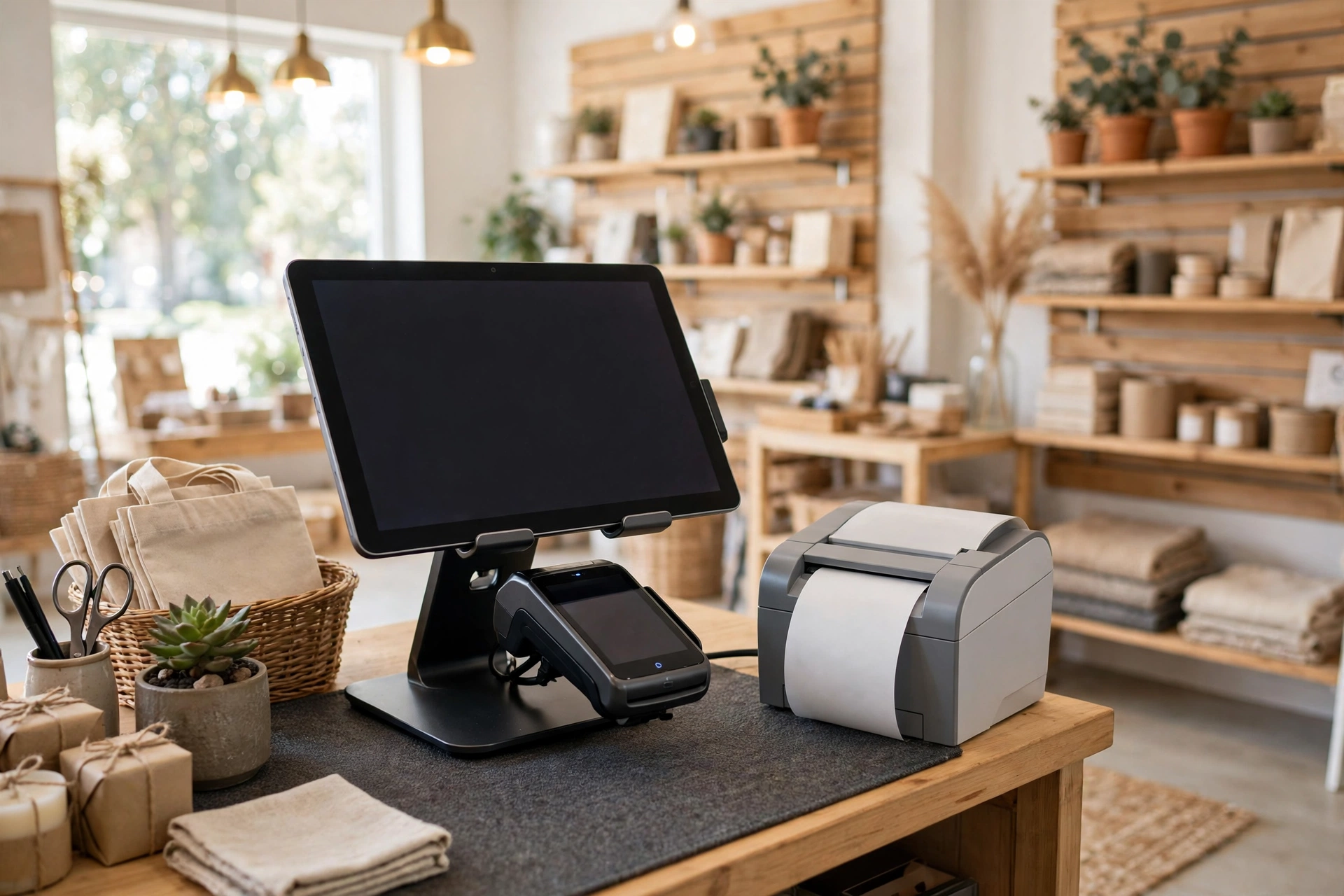
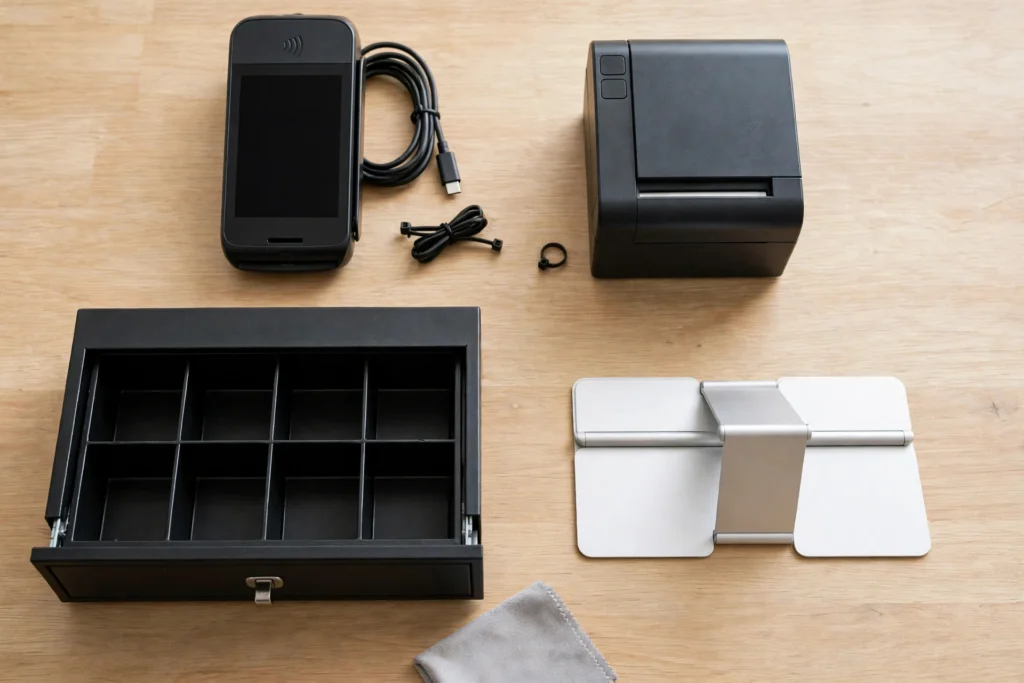
Hardware is a one-time cost, and you own it outright. A basic mobile card reader costs around $50 — Square’s first reader is often free or $49 to $59 — and it is all a market stall or a mobile seller needs. A basic hardware bundle for a single checkout counter, including a tablet stand, card reader, receipt printer and cash drawer, typically costs between $800 and $1,200. A full countertop station with a dedicated terminal can run $1,500 to $3,000, and a multi-terminal restaurant setup easily passes $5,000.
The honest range for a small business is $249 to $3,000 for hardware, depending on the setup. A food truck or mobile seller can start at $249 to $499; a small cafe or coffee shop at $299 to $599; a single-location restaurant at $599 to $1,499; a retail store at $299 to $1,499. Multi-location restaurants start at $1,499 to $5,000 or more. And you can start at zero: if you already own a smartphone or tablet, a free app and a $49 reader is a complete POS system for a very small business.
Setup and training is a cost owners forget to budget. Expect $200 to $1,000 for training and onboarding for a small business with 5 to 10 employees, more if you need menu builds, inventory imports or integrations with accounting software.
Payment Processing: The Cost That Never Stops
Processing fees come out of every single sale, every day, forever. The structure is either a simple flat rate — 2.6% plus 10 cents per transaction is the common one — or a more complex interchange-plus model where you pay the card networks’ interchange fee plus a fixed markup. Flat rate is simpler and easier to budget; interchange-plus is usually cheaper at higher volumes, because the markup is transparent and often lower than the flat rate on debit and standard cards.
The realistic band for small businesses in 2026 is 2.3% to 2.6% plus 10 to 15 cents per in-person sale on most plans, rising to 3.3% plus 30 cents for online or keyed-in transactions. Square’s free plan charges 2.6% plus 10 cents in person; Toast charges 2.49% to 2.99% plus 15 cents. The difference looks tiny — a few tenths of a percent — but on $30,000 a month in card sales, half a point of rate is about $150 a month, or $1,800 a year.
This is also why the processing question deserves its own reading. Our explainer on credit card processing fees breaks down where the money actually goes — interchange to the cardholder’s bank, assessments to the card networks, and the markup to your processor — and which of those three parts you can actually negotiate. Spoiler: only the markup.
The Real Monthly Bill: Three Worked Examples
The coffee cart. A mobile coffee cart with a Square free plan, a $49 card reader and a phone as the terminal. Software $0 a month, hardware $49 once, processing 2.6% plus 10 cents per sale. First-year cost excluding processing: about $49. At $8,000 a month in card sales, processing adds roughly $230 a month — and that, not the software, is the real cost of the system.
The single-location cafe. One register, a paid plan at $69 a month, a $900 hardware bundle, and $25,000 a month in card sales at 2.49% plus 15 cents. Software $69, processing about $660, hardware $25 a month spread over three years. Total: roughly $755 a month. Run your own numbers through our Credit Card Processing Fee Calculator to see how the rate changes the total at your volume.
The full-service restaurant. Three terminals on a mid-tier restaurant plan, $50,000 a month in card sales at about 2.49% plus 15 cents. Software $69 for the base plan plus $50 per extra terminal, processing about $1,300, hardware amortised. Total: roughly $1,730 a month — and processing is three-quarters of it. The restaurant that negotiates its processing rate down by 0.3 points saves about $150 a month, $1,800 a year, without changing anything else.
Cost by Business Type
| Business type | Hardware | Monthly software | Processing | First-year total |
|---|---|---|---|---|
| Food truck / mobile | $249–$499 | $0–$15 | 2.1–2.8% | $400–$800 |
| Small cafe / coffee shop | $299–$599 | $0–$15 | 2.1–2.8% | $600–$1,200 |
| Retail store | $299–$1,499 | $0–$50 | 2.1–2.8% | $600–$2,400 |
| Single-location restaurant | $599–$1,499 | $15–$50 | 2.1–2.8% | $1,200–$2,500 |
| Bar / nightclub | $599–$1,499 | $15–$50 | 2.1–2.8% | $1,200–$2,500 |
| Multi-location restaurant | $1,499–$5,000+ | $50–$150 | 2.1–2.6% | $3,000–$7,000+ |
Food trucks deserve a special mention: the whole cost to start a food truck runs $50,000 to $175,000 all-in, and the POS is one of the smallest lines in that budget — a $249 handheld terminal and a free plan is genuinely enough to start, and you can upgrade the software when the volume justifies it.
The Two Traps
Trap one: leasing hardware. POS leasing is one of the most expensive mistakes a small business can make. A typical lease runs $50 to $100 a month for 48 months — $2,400 to $4,800 in total — for equipment worth $500 to $1,500. One documented example: a Clover Station Duo on a 48-month lease at $75 a month costs $3,600, against a $1,499 one-time purchase price. You pay $2,101 extra for the same hardware, and you do not own it at the end. Buy outright, or use a card reader you already own.
Trap two: the add-on creep. Loyalty, online ordering, payroll, email marketing and extra terminals each carry their own monthly fee, and together they can quietly add $100 to $300 a month to a plan that was quoted at $69. Before you sign, ask for the full monthly total with every feature you actually need switched on — not the headline price for the base plan.
The Bottom Line
A POS system for a small business costs $0 to $200 a month for the software, $0 to $2,000 up front for the hardware, and 2.3% to 3.5% of every card sale in processing. Most small businesses spend $30 to $100 a month on the software side, and the card rate — not the subscription — decides the real cost over three years. Start with a free plan and a cheap reader if your volume is low, buy your hardware outright, and renegotiate the processing rate the moment your card sales grow. The cheapest POS system is rarely the one with the lowest monthly fee; it is the one with the lowest total cost at your sales volume.
Frequently Asked Questions
How much does a POS system cost per month for a small business?
Most small businesses spend $0 to $200 a month on POS software, plus 2.3% to 3.5% of each card sale in processing fees. A realistic monthly total is $30 to $100 for a very small business, $50 to $200 for a single-location shop, and $200 to $500 or more for a restaurant with multiple terminals.
Is a free POS system really free?
The app is free, but the processing is not — and free plans usually lock you into the provider’s payment processing at its standard rate, often 2.6% plus 10 cents per sale. At low volume that is fine; as sales grow, a paid plan with a lower card rate usually saves money overall.
Should I lease or buy POS hardware?
Buy. A typical 48-month POS lease costs $2,400 to $4,800 for equipment worth $500 to $1,500 — a Clover Station Duo leased at $75 a month costs $3,600 against a $1,499 purchase price. Leasing costs two to three times the purchase price and you do not own the hardware at the end.
What is the cheapest POS system for a small business?
For very small volume, Square’s free plan with a $49 card reader is the cheapest way to start — $0 a month for software, 2.6% plus 10 cents per sale. Once card sales pass roughly $10,000 to $15,000 a month, a paid plan with a lower processing rate usually costs less in total.