

Busy but Broke: The Freelance Billable-Hours Trap
There is a particular kind of freelance failure that looks, from the outside, like success. The calendar is full. Clients are happy. The week runs to 45 hours or more, every week, and turning down work feels impossible because there is always a queue for it. Then the year ends, the accounts are added up, and the total is nowhere near the salary this person left behind — sometimes tens of thousands short of it.
Nothing went wrong with their work. What went wrong was the arithmetic on the day they set their rate. They priced themselves the way an employee is priced, as if every working hour can be sold and as if a salary costs an employer nothing beyond the number on the payslip. Both assumptions are false, and together they quietly cut a freelancer’s real income by close to half. This article works through the maths exactly, shows where the unsold hours actually go, and sets out the three levers that fix the problem without working longer weeks.
The $28.85 illusion
Most freelance rates are born in one quick calculation. The freelancer takes the salary they want to match — say $60,000 a year — and divides it by the hours in a standard working year: 52 weeks at 40 hours is 2,080 hours.
$60,000 ÷ 2,080 = $28.85 an hour.
It looks reasonable. It even looks professional, neatly in line with what the same work pays inside a company. So they charge $28.85, or round it to $30 to feel safe, fill their diary — and walk straight into the trap. Because that division contains two hidden lies.
The first lie is that a freelancer has 2,080 sellable hours. An employee is paid for all 2,080: holidays, sick days, the slow Tuesday afternoons, the training days. A freelancer is paid only for hours a client agrees to buy, and a large share of every week is spent on work no client will ever pay for. The second lie is that $60,000 of salary and $60,000 of freelance billings are the same money. They are not. Behind a salary sits an employer quietly paying payroll taxes and funding insurance, retirement and paid leave. A freelancer has to fund all of that out of the same hourly rate. Price as if neither lie exists and you can be fully booked, genuinely in demand, and still end the year broke relative to the job you left.
Your real numbers, step by step
Run the same target honestly, one correction at a time.
Step 1: take your weeks off. Four weeks a year for holidays, illness and the gaps between projects is modest — most employees get more. 52 − 4 = 48 working weeks.
Step 2: count only billable hours. In a 40-hour week, roughly 30 hours are work a client pays for. The other ten go to running the business, as the next section breaks down. 48 working weeks × 30 billable hours = 1,440 billable hours a year — not 2,080. You have 640 fewer hours to earn your living from than the salary maths assumed.
Step 3: add the costs an employer used to carry. Self-employment tax, health insurance, retirement savings and unpaid leave now come out of your own pocket. A standard planning allowance for these is 25 percent on top of your target income. $60,000 × 1.25 = $75,000 you actually need to bill.
Step 4: divide what you must bill by the hours you can sell. $75,000 ÷ 1,440 = $52.08 an hour. At an eight-hour day, that is $416.67 a day.
Set those two rates side by side: $28.85, the illusion, and $52.08, the reality. The honest rate is 1.8 times the naive one. A freelancer charging the naive rate at full utilisation — billing every one of those 1,440 hours, which almost nobody manages — grosses $41,544, and after funding their own tax and benefits out of it, keeps the equivalent of roughly $33,000 against a $60,000 target. That gap, not laziness and not a lack of clients, is the entire busy-but-broke phenomenon.
Where the unbillable hours actually go
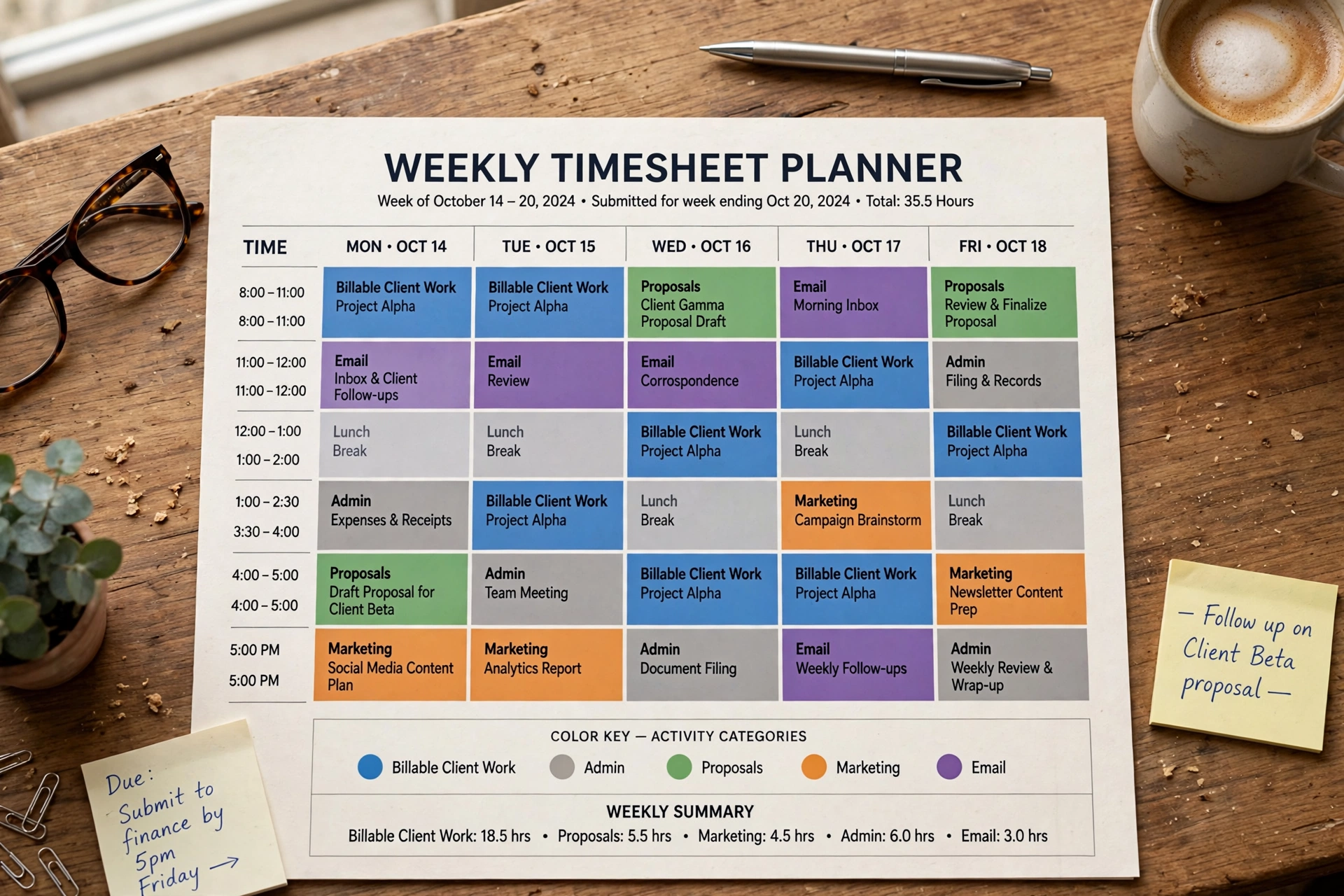
If only 30 of 40 hours are billable, where do the other ten go? They are not breaks, and they are not wasted. A realistic freelance week looks like this:
- Billable client work: 30 hours. The work itself — designing, writing, coding, consulting, producing.
- Admin, invoicing and bookkeeping: 3 hours. Raising invoices, chasing late ones, reconciling accounts, filing receipts, answering the accountant.
- Proposals and pitches: 3 hours. Scoping enquiries, writing quotes, discovery calls with prospects who may never hire you. Every won project carries the cost of the proposals that lost.
- Marketing and portfolio: 2 hours. Updating your site, posting work, keeping profiles current — the activity that produces next quarter’s clients.
- Non-billable communication and revision-chasing: 2 hours. Status emails, scheduling, feedback rounds that spill beyond the agreed scope, reminding clients to send the files they promised.
That sums to 40 hours, of which a client pays for 30. And this is the tidy version: many freelancers work 45-hour weeks, where the extra five hours are almost never extra billable work — they are more revisions, more chasing, more admin bleeding into evenings. The billable count stubbornly stays near 30 while the week grows around it, which is why working harder never seems to fix the income. You cannot sell the same 30 hours twice.
Why “just bill more hours” is a trap
Faced with the gap, most freelancers reach for the obvious lever: raise utilisation. Bill 35 hours a week instead of 30. Answer email at night so the days stay pure. Squeeze admin into weekends.
It fails for structural reasons, not willpower reasons. First, the unbillable work is not optional padding — stop invoicing, stop proposing, stop marketing, and within a quarter you have no clients left to bill. The ten hours are the business’s operating system; the thirty are just its output. Second, quality falls as utilisation climbs. Creative and technical work done in hour 38 of a week contains more errors, and errors generate the unpaid revision rounds that eat the following week. Third, burnout is a business risk, not a personal one: a solo freelancer who burns out does not get reduced output, they get zero output and a reputation problem at the same time.
Utilisation has a realistic ceiling around 30 to 32 billable hours in a 40-hour week for most service freelancers. Treat anything above that as a warning sign about your systems, not as a productivity win. The money has to come from somewhere else — and fortunately, it can.
The three levers that actually work
Lever 1: Correct the rate
The direct fix is the one from the maths above: charge the rate your billable hours and self-funded costs actually require. For the $60,000 target, that is $52.08 an hour, not $28.85. This feels like an enormous jump only because the starting rate was built on two false assumptions. You are not doubling your price; you are stopping a 45 percent discount you never meant to offer. The final section of this article covers how to move existing clients onto a corrected rate without losing all of them.
Lever 2: Raise the billable ratio with productised offers and retainers
You cannot bill admin hours, but you can shrink them per dollar earned. Productised offers — fixed-scope, fixed-price packages instead of open-ended hourly work — cut proposal time dramatically, because the scope conversation happens once, when you design the package, instead of on every enquiry. Retainers do the same for communication overhead: a client on a monthly retainer needs one agreement and one invoice a month, not a fresh negotiation per task. Both also smooth the gaps between projects, which protects the 48 working weeks assumption. Raising your billable share from 30 to 33 hours a week through packaging alone is worth more than a small rate rise, and it comes with less client resistance because the client experiences it as a simpler offer, not a higher price.
Lever 3: Cut admin with systems
The remaining lever is shrinking the ten unbillable hours themselves. Invoicing templates and automatic late-payment reminders take most of the chasing out of your week. A standard proposal template with pre-written scope, terms and pricing sections turns a two-hour quote into twenty minutes. A simple intake form filters out enquiries that were never going to hire you before they consume a call. None of this is glamorous, and none of it requires expensive software — it requires doing each recurring task once, properly, and never improvising it again. Every admin hour you remove either becomes billable or becomes rest, and both improve the year-end number.
Before you pick a lever, run your own figures rather than borrowing this article’s. Enter your target income, your weeks off, your honestly-counted billable hours and your tax and benefits allowance into the Freelance Rate Calculator and look at the hourly and day rate it returns. Most freelancers find their required rate is 50 to 80 percent above what they currently charge. That number, not the market gossip about what freelancers “usually charge,” is the floor your pricing decisions should start from.

Moving existing clients to the corrected rate
The fear that stops most freelancers is not the maths — it is the conversation. A client paying $30 an hour will not happily accept $52 tomorrow, and pretending otherwise helps nobody. A staged move works better than a sudden one.
Start with new clients. Every enquiry from today onward gets the corrected rate, quoted as project prices built from it. New clients have no old price to compare against, and within a few months a growing share of your week is billed at the honest rate without a single difficult conversation.
For existing clients, give notice and a reason tied to costs, not worth. Rates that were set years ago get reviewed annually in almost every industry; a letter saying your rate moves to a new figure from the first of next quarter, because it now has to cover the tax, insurance and pension costs an employer would carry, is a normal business communication. Offer a bridge: existing projects finish at the old rate, and a retainer booked before the change keeps the old rate for a fixed period. Clients who value the work mostly accept a staged rise, especially with notice.
Accept that a few will leave, and do the arithmetic on that before you panic. Losing a client who filled ten hours a week at $30 frees ten hours you can refill at $52 — you need to replace only about six of those hours to earn the same money, and you get four hours of your week back in the trade. The clients who leave over a cost-based correction were, in the honest accounting, the ones your old rate was subsidising. A smaller book of correctly priced work out-earns a full book of subsidised work, and it leaves you with evenings.
Frequently asked questions
How many billable hours should I plan for in a week?
For most service freelancers, 25 to 32 billable hours in a 40-hour week is the realistic band; 30 is a sound planning figure. If your own week consistently shows fewer, look at your admin and proposal load before your work ethic — that is where the hours are going, and systems and productised offers recover more of them than longer days do.
What percentage should I add for tax and benefits?
A 25 percent allowance on top of your target income is a common planning figure covering self-employment tax, a health insurance contribution, retirement savings and unpaid leave. Higher earners, and freelancers in states with significant income tax, often need 30 percent or more. The right check is to compare the allowance against last year’s actual tax bill and premiums.
Should I charge hourly or per project?
Use your corrected hourly rate either way — the difference is who sees it. Hourly billing shows the client the rate directly. Project pricing keeps the rate internal: estimate the hours honestly, multiply by your true rate, add a margin for the unexpected, and quote the total. Never quote a project price that works out below your floor rate when the hours are counted honestly.
What if clients in my field will not pay the corrected rate?
Then the field, as you are currently serving it, cannot fund the income you need — and it is better to learn that from the arithmetic than from another broke year. The usual answers are to move up-market to clients with bigger budgets, productise so your effective rate rises without the headline rate changing, or narrow to the services where your hours command the most. What does not work is staying fully booked at a rate the maths has already rejected.