Why Your Marketplace Payout Is Smaller Than You Expected
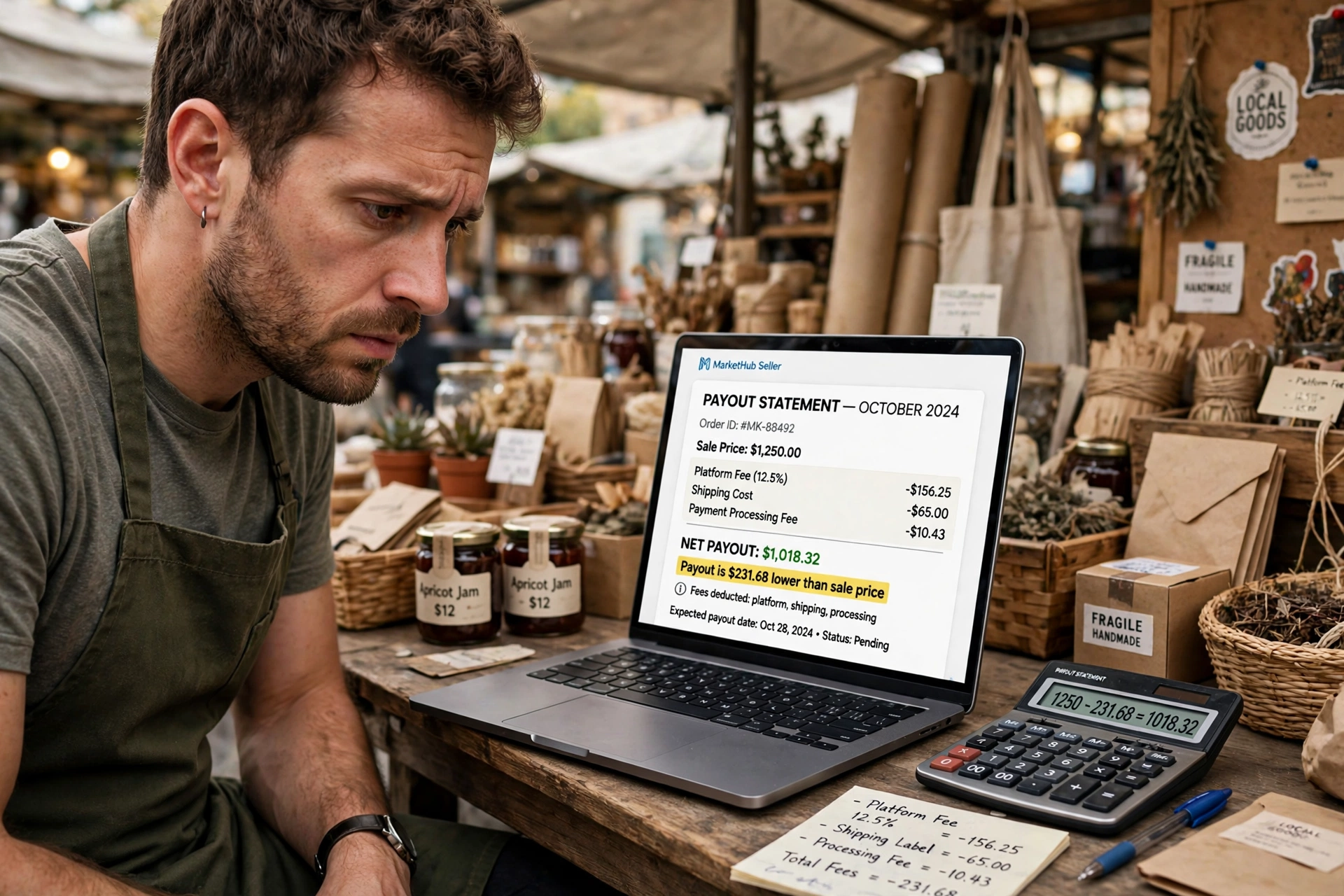
Your first sale feels like a win right up until the payout lands. The item sold for $56. The money that arrives is $50.23 — or $41.83, or some other number that is plainly not $56. Your first thought is that the marketplace made a mistake.
Almost always, it did not. You priced the sale using the one fee you knew about, and the marketplace charged you every fee that actually applies — a stack of them, several calculated on more than your item price. The statement only makes sense when you rebuild it line by line.
This guide does that rebuild for eBay, Etsy and Amazon: the five causes behind nearly every short payout, how to reconcile a payout against the fee schedule to the cent, and how to price so it never happens again.
The short answer: the fee is never the fee you heard about
Every marketplace has a headline number — eBay 13.6%, Etsy 6.5%, Amazon 15%. Each is real, and each is incomplete three ways.
First, the headline percentage is usually charged on more than the item price. eBay charges its final value fee on the item price plus the shipping you charged plus the sales tax collected. Etsy charges its transaction fee on the price plus shipping. Amazon charges its referral fee on the total the buyer pays, including delivery charges.
Second, flat charges ride on top of every percentage: a $0.40 per-order fee here, a $0.20 listing fee and a $0.25 processing charge there. On a $100 sale these are rounding. On a $15 sale they are several percentage points, which is why small orders always feel more heavily taxed than large ones.
Third, some fees only appear on some sales: an advertising fee when the buyer arrived through an ad, a fulfilment fee when the marketplace ships the item for you, a reserve when the marketplace holds your money before releasing it. None show up in the headline rate. All show up in your payout.
Cause 1: The percentage was charged on shipping and tax, not just your price
Take a clean eBay example. You sell an item for $90 and charge $10 for shipping, and you expect 13.6% of the $90 — $12.24, plus $0.40, so about $12.64 in fees. That is not what eBay does. Under eBay’s published selling fees schedule, the final value fee is 13.6% of the total amount of the sale — $90 plus $10 shipping is $100 — plus the per-order fee: $13.60 plus $0.40 is $14.00 exactly, and you keep $86.00. The “missing” $1.36 was never an error; it was the fee on the shipping.
Add sales tax and the base grows again: on an order where the buyer paid $8 tax, the fee is 13.6% of $108 — $14.69 — plus $0.40, for $15.09. Identical items sold into different states can legitimately produce different fees. Etsy works the same way: its 6.5% transaction fee is charged on the price plus shipping and gift wrap, and free shipping does not dodge it — folding postage into the price leaves the buyer’s total, and the fee on it, unchanged.
Cause 2: Flat per-order fees quietly raise your real rate
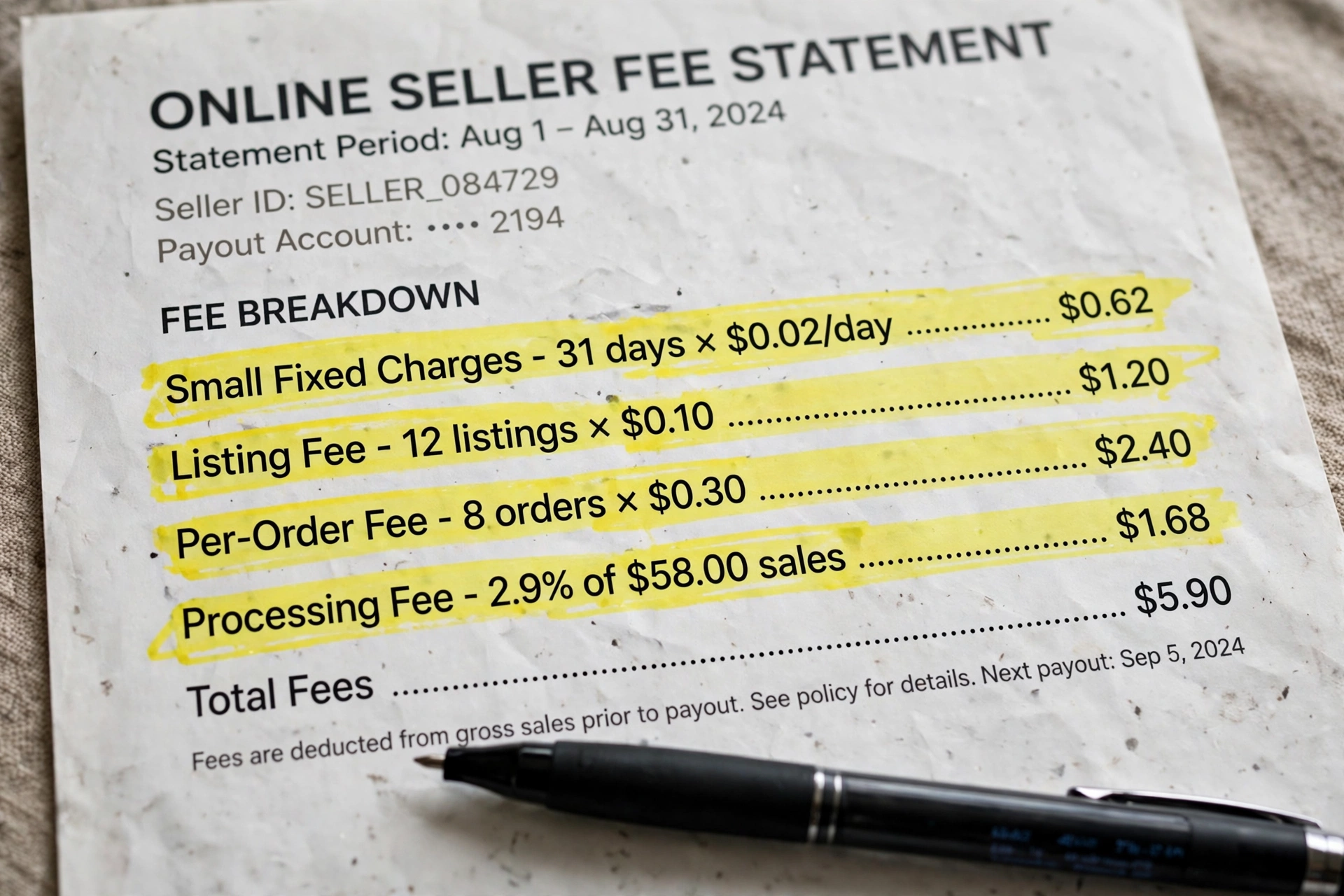
Percentages scale with price. Flat fees do not — which is why they punish cheap items.
Run the standard Etsy sale. An item sells for $50 and the buyer pays $6 shipping, a $56 order. Etsy’s Fees and Payments Policy sets three charges on almost every order. The listing fee is $0.20. The transaction fee is 6.5% of $56, which is $3.64. Payment processing through Etsy Payments is 3% of $56 plus $0.25, which is $1.68 plus $0.25, or $1.93. Add them: $0.20 plus $3.64 plus $1.93 is $5.77 — that is 10.3% of the order, not the headline 6.5%. The seller keeps $50.23 of the $56.
Shrink the order and it gets worse. A $15 item with $4 shipping is a $19 order: listing $0.20, transaction fee $1.24, processing $0.82 — total $2.26, which is 11.9% of the order. Grow it to a $100 item with free shipping and the fees are $0.20 plus $6.50 plus $3.25, or $9.95 — 9.95%. The bigger the order, the closer your real rate sits to the percentage stack; the smaller the order, the more the flat fees dominate.
eBay shows the same shape: on a $15 sale, 13.6% is $2.04, plus the $0.40 per-order fee (orders over $10 pay $0.40; orders of $10 or less pay $0.30) — $2.44, or 16.3% of the sale. The $0.40 did that.
Cause 3: Advertising fees you agreed to without noticing
Etsy’s Offsite Ads programme advertises your listings on search engines and social platforms. When a buyer clicks one of those ads and buys from your shop within 30 days, Etsy charges an advertising fee on that order: 15% of the order total if your shop made less than $10,000 in the previous 365 days, 12% once it has made $10,000 or more, capped at $100 per order. Below the threshold it is optional; above it, mandatory.
Return to the $56 Etsy order, whose ordinary fees were $5.77. If it arrived through an Offsite Ad while your shop was under the threshold, the ad fee is 15% of $56 — $8.40. Total fees become $14.17, or 25.3% of the order, and you keep $41.83 before item and postage costs. Nothing malfunctioned: the sale cost two and a half times what you budgeted, because it was an ad sale priced as an ordinary one.
eBay’s version is Promoted Listings: you choose an ad rate, commonly 2% to 12%, paid on top of the final value fee when a promoted listing sells — a 5% rate takes the combined percentage to about 18.6% before the per-order fee. Amazon’s version is Sponsored Products: pay-per-click spend deducted from the same balance, so the payout shrinks even though the order’s own fees were exactly as expected.
Cause 4: Reserves, holds and timing make good money arrive late
Sometimes the payout is not smaller — it is just not all there yet, which feels identical at the bank.
Marketplaces hold money for reasons unrelated to fees. New sellers commonly wait until delivery is confirmed and a track record exists. Orders flagged for review — an unusual amount, a mismatched address, a dispute — can have funds reserved while the marketplace looks, and a change to your bank details or verification can pause disbursement entirely. Amazon added a timing change in 2026: from March 12, FBA funds are held until seven days after delivery is confirmed, rather than being released around shipment. The fees are the same; the calendar moved.
The statement tells you which problem you have: a fee appears as a named line with an amount; a hold appears as a balance that exists but has not disbursed. Account total right but bank transfer short means timing. Account total short means a fee — one of the other four causes.
Cause 5: On Amazon, fulfilment is a second fee stack entirely
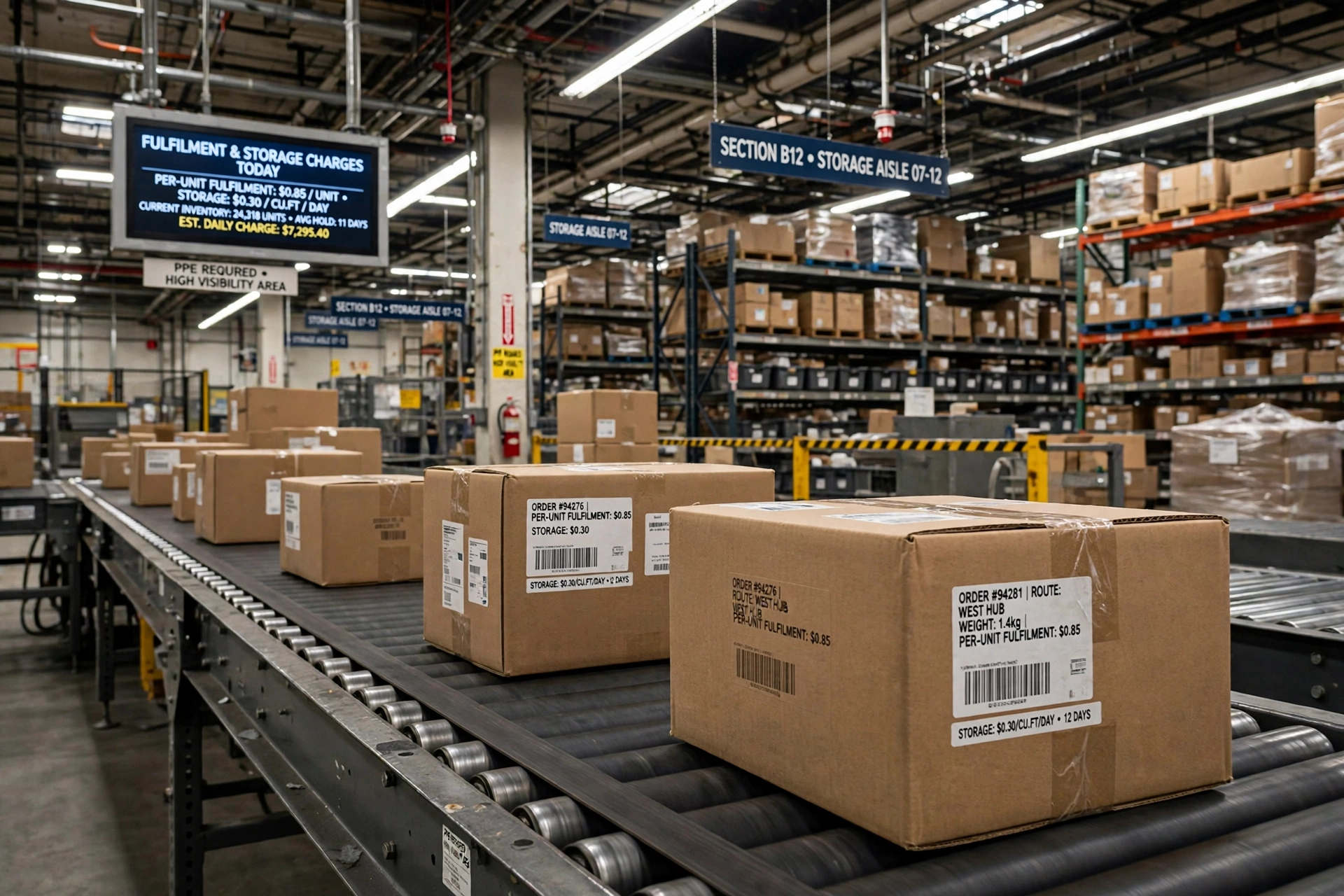
The marketplace charge is the referral fee, a percentage of the total the buyer pays. Amazon’s published referral schedule runs from 8% to 45% depending on category; most general categories — Home and Kitchen, Toys and Games, Sports and Outdoors among them — pay 15%. Then comes the selling plan: $0.99 per unit on Individual, or $39.99 a month on Professional; the break-even is about 40 units a month.
The warehouse charge is FBA. If Amazon stores and ships your product, you pay a fulfilment fee per unit based on size and weight — starting at about $2.43 for a small, light, low-priced item in 2026 — plus monthly storage, plus, from April 17, 2026, a 3.5% fuel and logistics surcharge on the fulfilment fee. The surcharge is not in the published rate-card figures, so a seller checking Amazon’s own table still underestimates the real charge.
Put the stack together on a $100 home product sold through FBA on the Professional plan. Referral fee: 15% of $100 is $15.00. Fulfilment fee: about $5.30. Surcharge: 3.5% of $5.30 is about $0.19. Total: about $20.49 — roughly a fifth of the sale price, before product cost, inbound shipping or storage. Run a $25 kitchen gadget through the same stack and you get $3.75 referral, the same $5.30 fulfilment and $0.19 surcharge — about $9.24, or roughly 37% of the price. The fulfilment fee barely moves when the price falls, which is why cheap, heavy products bleed on FBA. If an Amazon payout looks inexplicable, separate the two stacks first: almost every mystery lives in one or the other, and they are fixed in different ways.
How to reconcile a payout, line by line
Pick one order — not a whole month — and rebuild it from the fee schedule until your number matches the marketplace’s to the cent.
Step 1: Start from the buyer’s total, not your price. Item price, shipping charged, gift wrap, sales tax collected — that total is the base most percentages are calculated on.
Step 2: Apply the percentage fees to that total. eBay’s final value fee at your rate — 13.6% with no store in most categories, 12.7% with a Basic store or above. Etsy’s transaction fee at 6.5%. Amazon’s referral fee at your category rate. Processing where it is separate: Etsy takes 3% plus $0.25; on eBay, processing is already inside the final value fee, so do not add it twice.
Step 3: Add every flat charge. Listing fees, per-order fees, per-unit plan fees — small, and exactly where reconciliations fail.
Step 4: Ask the ad question. Did this order arrive through an ad? Look for an Offsite Ads fee on Etsy, a Promoted Listings charge on eBay, or click spend in the same disbursement period on Amazon.
Step 5: Ask the warehouse question, on Amazon. Add the fulfilment fee for the item’s size tier, the 3.5% surcharge on it, and any storage or returns charges for the period.
Step 6: Subtract from the buyer’s total and compare. If your figure matches the statement, the payout was correct and your pricing model was wrong — the fixable problem. If it does not match, you have the one thing worth contacting support about: a specific order, a specific line, and your arithmetic beside theirs. Reconcile monthly and you will also catch fee changes — all three platforms adjusted their schedules during 2026 — before they eat a quarter.
How to price so the payout never surprises you again
The cure is to price backwards from the payout you need, using your real fee rate, not the headline rate.
Start with your costs — the item, postage and packaging, and the profit you intend to keep — then gross the price up for the full fee stack: percentage on the buyer’s total, flat fees per order, and an honest allowance for ad-driven sales. If a third of your Etsy sales arrive through Offsite Ads at 15%, your blended ad cost is about 5% of revenue, and it belongs in your prices.
The fastest way to get the stack right for a specific item is to run the exact sale — price, shipping, marketplace, ad setting — through our Marketplace Fee Calculator and read the fee lines it returns. Compare the three marketplaces on the same item while you are there: the cheapest channel for a $15 item is often not the cheapest for a $100 item, because flat and fulfilment charges fall differently.
Two habits help beyond any single calculation: bundle low-priced items, because one $45 order carries the flat fees once instead of three times, and re-run your numbers whenever a marketplace announces a fee change.
The bottom line
A short payout is almost never a marketplace error. It is a fee charged on shipping and tax that you calculated on price alone, flat charges that bite hardest on small orders, an ad fee on sales that arrived through advertising, money held rather than taken, or — on Amazon — a warehouse bill underneath the marketplace bill. Rebuild one order line by line and the mystery resolves into arithmetic — and price from that arithmetic from then on.
Frequently asked questions
Why is my Etsy payout less than my sales total?
Because Etsy deducts three fees from nearly every order — a $0.20 listing fee, a 6.5% transaction fee on the price plus shipping, and processing at 3% plus $0.25 — together about 10% of a typical order. If any sales arrived through Offsite Ads, add 15%, or 12% for shops over $10,000 a year, on those orders. On a $50 item with $6 shipping, the standard fees alone are $5.77.
Does eBay really charge its fee on shipping and sales tax?
Yes. The final value fee is calculated on the total amount of the sale: item price, plus shipping charged, plus any sales tax collected. On a $90 item with $10 shipping, the 13.6% applies to $100 — $13.60 plus the $0.40 per-order fee is $14.00. Free shipping does not avoid it; the shipping cost is simply inside the item price instead.
Why did my Amazon payout drop even though my sales grew?
Growth usually means more FBA units, and every unit carries a fulfilment fee plus the 3.5% fuel and logistics surcharge that began in April 2026, on top of the referral fee. Amazon’s March 2026 timing change — FBA funds held until seven days after delivery is confirmed — slows the cash further. More sales, more warehouse charges and slower release can add up to less cash in hand in a given month.
How can I check a marketplace’s fee before I list an item?
Rebuild the sale the way this article reconciles a payout: take the full amount the buyer will pay, apply the percentage fees to that total, add the flat charges, include an ad fee if the sale is likely to come through advertising, and add fulfilment if the marketplace ships it. If your rebuilt figure matches what the marketplace later deducts — and it should, to the cent — your price was built on the channel’s real cost.