How Much Does It Cost to Start a Food Truck in 2026? A Line-by-Line Budget
A food truck looks like the cheap way into the restaurant business, and compared with a brick-and-mortar restaurant it is. A comparable restaurant costs five to ten times as much to open. But cheap is relative: launching a food truck in the US in 2026 typically costs $50,000 to $175,000 all-in, and the guides that quote a single number are hiding how wide the range is. A used truck in a low-regulation market can open for under $50,000. A new custom build in a major city can pass $200,000 before it serves its first taco.
The range exists because six separate buckets add up to the total: the vehicle, the kitchen equipment and build-out, permits and licenses, initial inventory, insurance and deposits, and working capital to survive the first few months. This guide prices each bucket with 2026 figures, then shows three realistic budgets — lean, mid-range, and premium — so you can see which one you are actually building.
The Short Answer
Most first-time operators should plan on $50,000 to $175,000 all-in. The truck itself is roughly half the total budget. Everything else — kitchen build-out, permits, wrap, initial inventory and working capital — adds up faster than most first-time operators expect. The typical first-time used-truck owner lands around $85,000 to $120,000 all-in, according to 2026 trade guides, while a food trailer — a cheaper entry point that trades capacity for cost — lands at $37,000 to $80,000.
A cart is cheaper still: $4,000 to $20,000 for a fully equipped cart with permits, and most operators spend $8,000 to $15,000. But a cart cannot cook a full hot menu, so it is a different business, not a cheaper version of the same one.
The Truck Itself
The vehicle is the biggest single line, and the new-versus-used choice decides most of your budget. A used, fully equipped truck in good condition runs $20,000 to $50,000 by some 2026 guides, and $40,000 to $80,000 by others — the spread reflects condition, age, and whether the kitchen is already fitted. A used truck can be operational within weeks, but budget $5,000 to $15,000 for a pre-purchase mechanical inspection and any kitchen re-fit. A step van bought as a shell and equipped separately is the entry point: $20,000 to $40,000 for the vehicle, then the kitchen on top.
A brand-new custom build from a specialist fabricator runs $75,000 to $175,000 and takes three to six months to deliver. A new purpose-built truck from a builder such as Golden State Trailer or Custom Concessions costs $70,000 to $100,000 or more, with a three to six month lead time. Buying new gets you a warranty and a kitchen built to your menu, but it also means paying rent on a commissary and insurance for months before you sell anything.
A converted cargo trailer sits in between: $10,000 to $45,000, which lowers the upfront cost but limits cooking capacity and requires a separate tow vehicle. Trailers are the right choice for a simple menu — coffee, ice cream, pre-made sandwiches — and the wrong choice for a full hot kitchen.
Kitchen Equipment and Build-Out
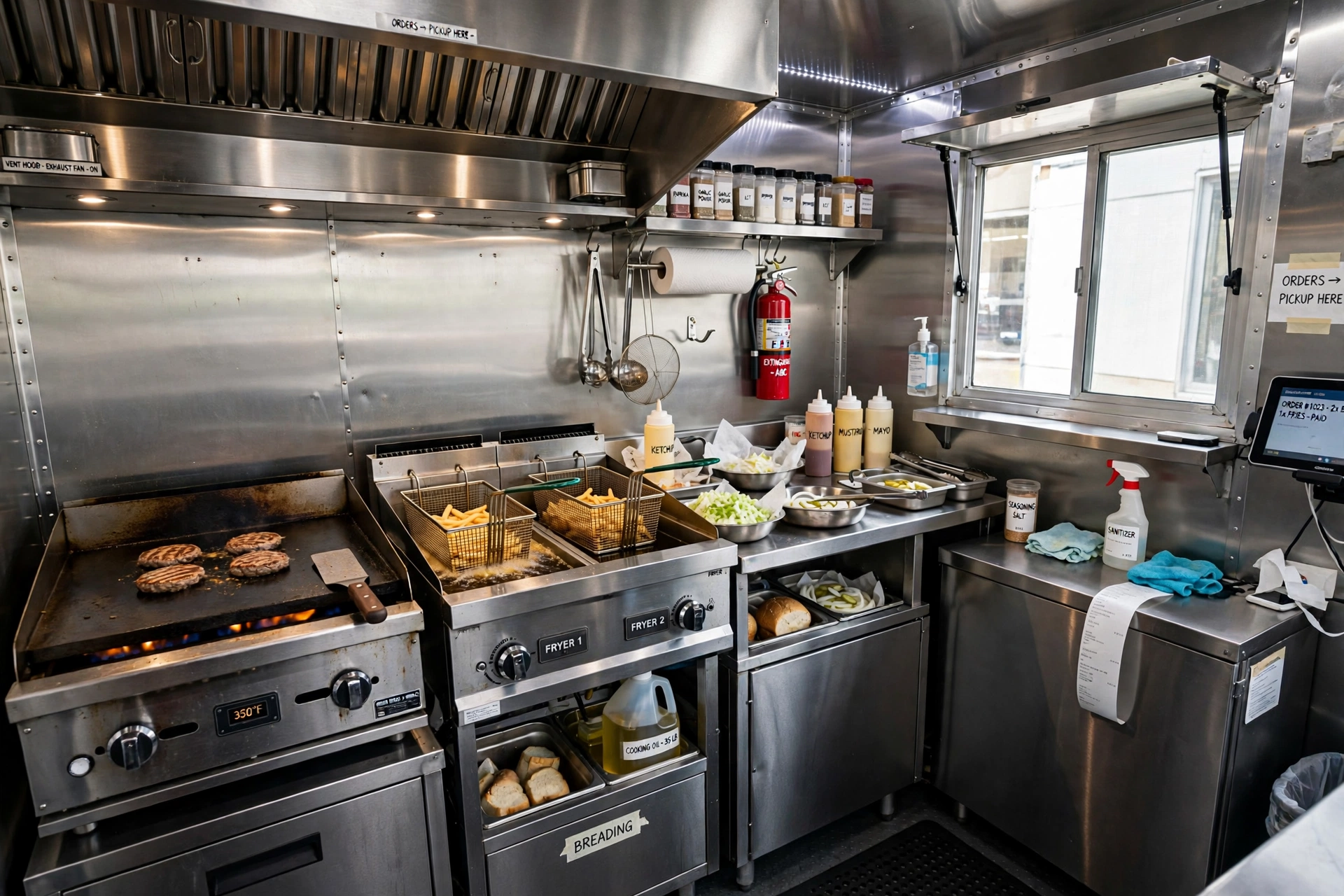
If you buy a shell, the kitchen is the second-biggest line: $10,000 to $40,000 for a full commercial build-out, or $8,000 to $35,000 in the leaner guides. A three-bay commercial kitchen in a truck needs a commercial range ($3,000 to $8,000), a fryer ($1,500 to $4,000), a griddle ($1,000 to $3,000), refrigeration ($2,000 to $6,000), a ventilation hood and fire suppression system ($5,000 to $12,000), and a three-compartment sink ($800 to $2,000).
The ventilation and suppression system is the surprise cost. It is required by most health departments, it is expensive to install in a mobile unit, and it is the line first-timers most often forget. A used truck that comes pre-equipped saves this build-out time and cost, which is why pre-equipped trucks at $35,000 to $65,000 are often better value than a cheap shell plus a full fit-out.
Branding is a smaller but real line: a truck wrap, signage and branding runs $2,500 to $8,000. A plain truck with a magnetic sign is cheaper and looks it; customers decide whether to queue at a truck they have never seen based almost entirely on how it looks from twenty feet away.
Permits and Licenses
Permits and licensing are the most variable and unpredictable cost in the whole budget. Across all required licenses — business license, food handler certification, health department permit, mobile food vendor permit, and fire safety inspection — most operators pay $1,500 to $5,000 in total. But that range hides city-level extremes: annual permit costs run from about $590 in Indianapolis to $17,000 or more in Boston, and in cities like Los Angeles, New York, and Chicago, mobile food vendor permits alone can cost $1,000 to $3,000 and carry waitlists of months to years.
The permits you need, in order: a business license from your city, a food handler certification for everyone who touches food, a health department permit for the truck itself, a mobile food vendor permit from the city, and a fire safety inspection for the cooking equipment. Some cities add a commissary agreement as a precondition for the health permit, which means you cannot get licensed until you have signed one.
Start this process early. A new custom build takes three to six months to deliver, and a permit waitlist can take just as long. The operators who open on schedule are the ones who applied for permits the week they ordered the truck, not the week it arrived.
The Costs Everyone Forgets
Three lines catch first-timers out, because none of them appears in the headline startup figure.
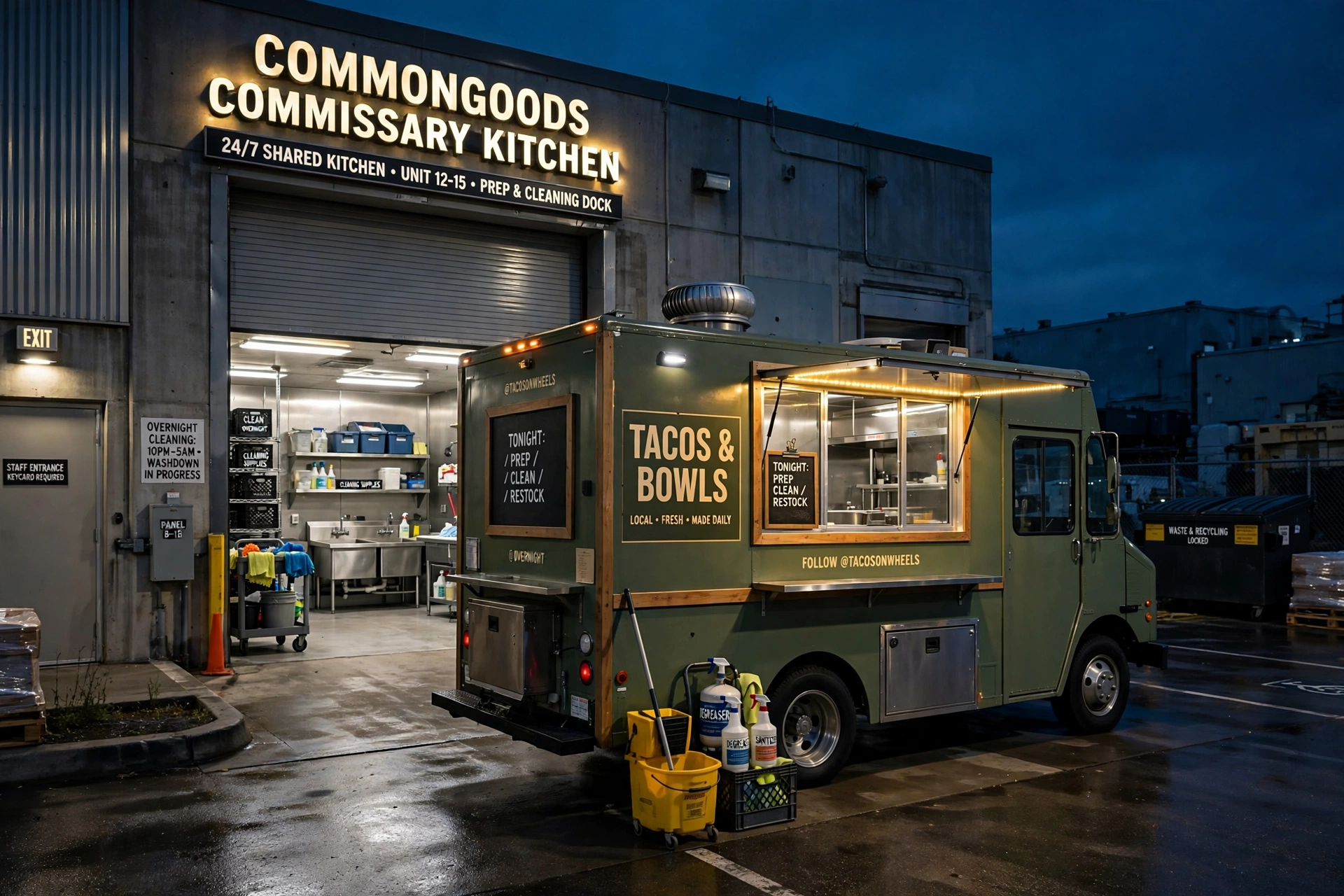
The first is the commissary. Most states require food trucks to operate from a licensed commissary kitchen for food prep, equipment washing, and overnight storage, and most jurisdictions require a signed agreement before they issue a health permit. Commissary rent runs $300 to $1,500 a month — $3,600 to $14,400 a year — with California and the Northeast at the top of the range. It is non-negotiable, and it is the most commonly overlooked ongoing cost in the business.
The second is insurance. Food truck insurance runs $2,000 to $4,500 a year for the full package: commercial auto, general liability, and product liability. Insureon’s median prices paid by its food truck customers in September 2026 were $440 a year for general liability and $2,509 for commercial auto. You need all three — a truck that hits a car, a customer who gets sick, and a kitchen fire are three different policies.
The third is working capital. One 2026 trade guide puts the cash reserve for a truck at $5,000 to $20,000; a trailer guide says $3,000 to $8,000. A fuller budget — a three-month operating reserve — runs $10,000 to $20,000. You need it because the first months are slow: you are learning your locations, your menu, and your costs, and the truck still needs fuel, commissary rent, and insurance whether you sell fifty meals or five.
Initial inventory is smaller: $1,500 to $3,500 for the first stock of food, packaging, and disposables. A point-of-sale system and payment processing add a few hundred dollars to set up, plus about 2.6 percent plus 15 cents per card transaction on every sale after that.
The Full Budget, Line by Line
| Line item | Low | Typical | High |
|---|---|---|---|
| Used food truck (vehicle only) | $20,000 | $40,000–$50,000 | $80,000–$100,000 |
| New custom build (vehicle + kitchen) | $75,000 | $100,000–$130,000 | $175,000–$200,000 |
| Converted trailer | $10,000 | $25,000 | $45,000 |
| Kitchen equipment and build-out | $10,000 | $18,000 | $40,000 |
| Truck wrap, signage and branding | $2,500 | $5,000 | $8,000 |
| Permits, licenses and inspections (first year) | $1,500 | $3,000 | $5,000+ |
| Commissary kitchen (annual) | $3,600 | $7,200 | $14,400 |
| Insurance (annual) | $2,000 | $3,000 | $4,500 |
| Initial inventory | $1,500 | $2,500 | $3,500 |
| Working capital (2–3 months) | $8,000 | $15,000 | $25,000 |
| All-in launch, used truck | $50,000 | $85,000–$120,000 | $175,000 |
That table is why the guides disagree: a lean used-truck build in a low-cost state and a premium new build in California are barely the same business. Work out which row you are on before you believe any single number.
Three Realistic Budgets
Lean — under $50,000. A used step van or a food cart, a simple menu, a low-regulation city, and a trailer rather than a truck. Total startup with working capital lands at $37,000 to $80,000 for a trailer setup. This is the budget for testing a concept, not for running a full hot menu in a major metro.
Mid-range — $85,000 to $130,000. A used truck, pre-equipped or lightly refitted, a full hot menu, a mid-size city, and a three-month cash reserve. This is where most first-time operators land, and it is the budget the 2026 guides converge on.
Premium — $150,000 and up. A new custom build, full kitchen, major metro permits, and a six-month reserve. A full build in a major metro runs about $175,000, and a premium new build in California passes $200,000. This is the budget for a truck that is meant to be a brand from day one, not a test.
What It Earns Back
A food truck doing $25,000 a month in revenue is a useful benchmark. Food costs run 28 to 35 percent ($7,000 to $8,750), labor $5,000 to $7,500 with one employee, commissary and overhead $1,500 to $3,000, insurance and permits $300 to $500, and fuel $400 to $1,000 — leaving $4,750 to $10,800 in gross profit before loan payments and owner compensation. The margin is real, but it is thin, and it depends on keeping food cost under 35 percent and the truck moving to the locations that sell.
Paying for It
Most first-timers fund the truck with savings plus a loan. The SBA’s microloan program goes up to $50,000, and its 7(a) loans go up to $5 million, which covers any truck build. Equipment financing is also common: the truck itself is the collateral. A lender will want a business plan with the line items above, a commissary agreement, and proof that the permits are in progress — which is another reason to start the permit process before you ask for money.
The Bottom Line
Starting a food truck in 2026 costs $50,000 to $175,000 all-in, with most first-time operators landing at $85,000 to $120,000 for a used truck with a full kitchen and a three-month cash reserve. The truck is half the budget; the kitchen, permits, commissary, insurance, and working capital are the other half, and the permit line is the one that varies most by city — from under $600 a year in Indianapolis to over $17,000 in Boston. Price your city before you price your truck, keep three months of cash in reserve, and do not sign a build contract until the permits are already in motion.
Permits are the most unpredictable line in this budget — see how much a business license costs before you price your city.