
How to Manage a Remote Team Across Time Zones: Overlap Hours, Async Rules and Fair Meeting Rotations
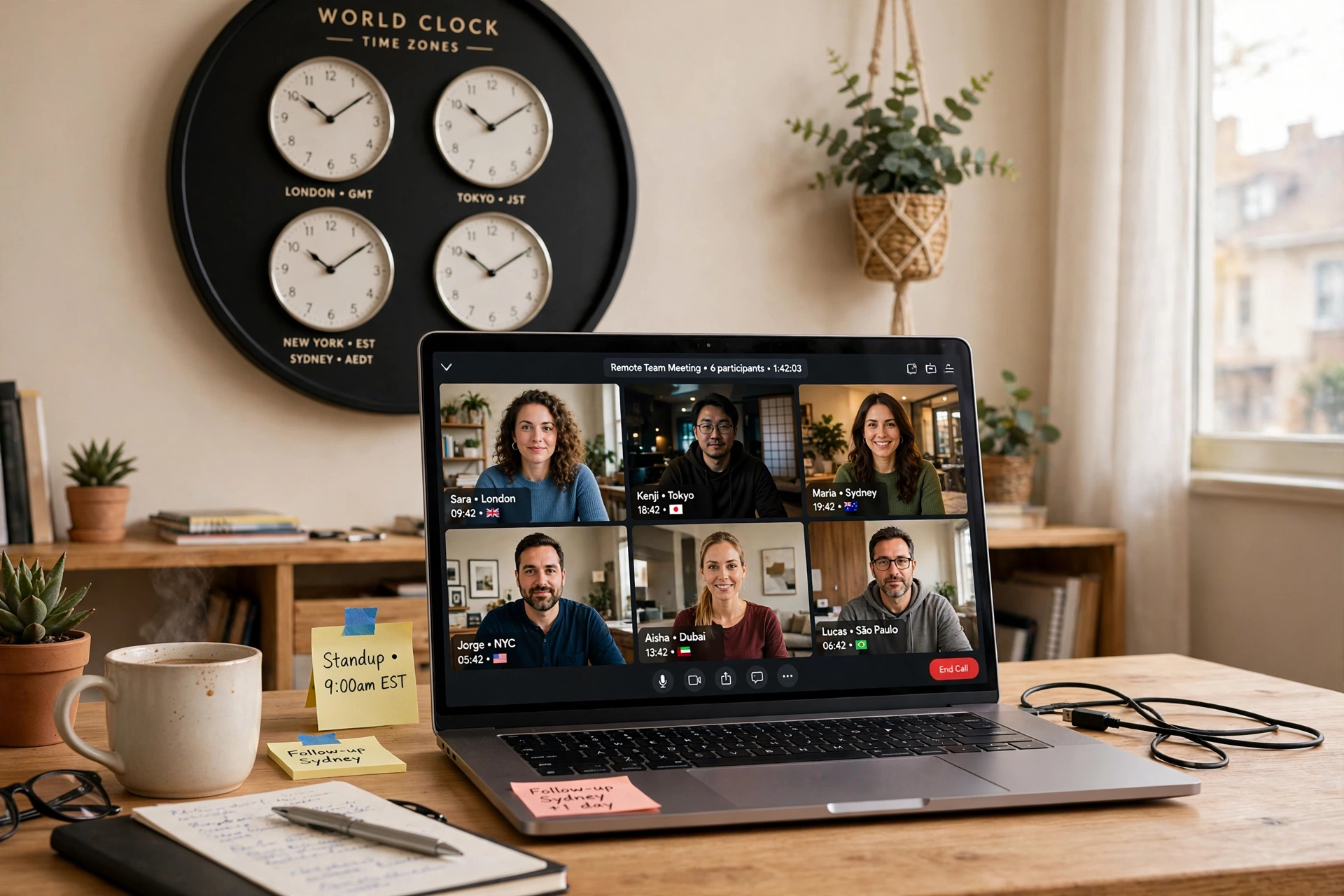
Managing a remote team across time zones is not really a scheduling problem. It is a fairness problem wearing a scheduling costume. Every team spread across regions has one scarce resource — the hours when everyone is awake and working at the same time — and the way a manager spends those hours decides whether the team feels like one team or like several teams that happen to share a chat channel. Get the system right, and distance becomes an advantage: work can move around the clock. Get it wrong, and the same person takes the midnight meeting every week, decisions stall for a day at a time, and the quietest time zones slowly stop speaking up.
The research gives managers a reason to take this seriously rather than treating it as an inconvenience. Microsoft’s 2025 Work Trend Index found that 30% of meetings now span multiple time zones, up eight percentage points from 2021. A study of more than 12,000 employees published in Organization Science found that greater time-zone distance reduced rich, synchronous communication and pushed more work into people’s personal hours. Buffer’s State of Remote Work survey found that 62% of remote workers had teammates in multiple time zones, yet only 14% named time zones as their single biggest struggle — a sign that most teams cope, but that the coping often falls unevenly on individuals.
Start by measuring the spread, not by fixing the calendar
Before setting any rule, map the team honestly. List every member, their location, their normal working hours in local time, and the hours they actually overlap with the rest of the team. Then sort the team into a spread band, because each band needs a different operating model.
A spread of 0 to 3 hours, for example United States East Coast to West Coast, is sync-friendly: the team can hold four or more hours of overlap and run a fairly normal meeting rhythm. A spread of 4 to 7 hours, such as the United States and Europe, is overlap-anchored: the team gets two to three hours together and must protect them. A spread of 8 hours or more, such as the United States and the Philippines or Australia, is async-first: the team may share only an hour, sometimes none, and the whole system has to run on writing and handoffs rather than live conversation.
This measurement also exposes the hidden cost. If one person overlaps with headquarters only between 9 p.m. and midnight their time, that is not an overlap window; it is an unpaid shift. Naming it as such is the first step to fixing it, either by shifting that person’s hours with their agreement and compensation, rotating the burden, or redesigning the role so it does not need daily live contact.
Protect a small overlap window and spend it on the right work
The most common mistake is trying to maximise overlap — stretching everyone’s day so the team shares as many hours as possible. The result is exhausted people and a calendar full of meetings that did not need to be live. A better rule is to protect a small window, typically two to four hours depending on the spread, and to reserve it strictly for work that genuinely benefits from people being together: decisions with real trade-offs, complex problem-solving, incidents and urgent customer problems, sensitive feedback, and relationship-building such as kickoffs and celebrations.
Everything else moves to writing. Status updates, routine approvals, information sharing, document feedback and simple questions do not need a meeting, and putting them in the overlap window wastes the scarcest resource the team has. A practical test helps: if the meeting would still be useful as a written update with a 24-hour response window, it should be a written update. If the answer depends on reading the room, resolving a disagreement or brainstorming under ambiguity, it earns a live slot.
For a team with a four-hour gap, a workable window might be 10 a.m. to 1 p.m. Pacific, which is 1 p.m. to 4 p.m. Eastern. For an eight-hour gap, the window may be a single hour, and the manager should treat that hour as precious: one focused session, not three back-to-back calls. Teams with no practical overlap should stop pretending otherwise and build a fully async rhythm with a weekly recorded update instead of a daily standup nobody can attend.
Make async the default, with rules that replace the corridor
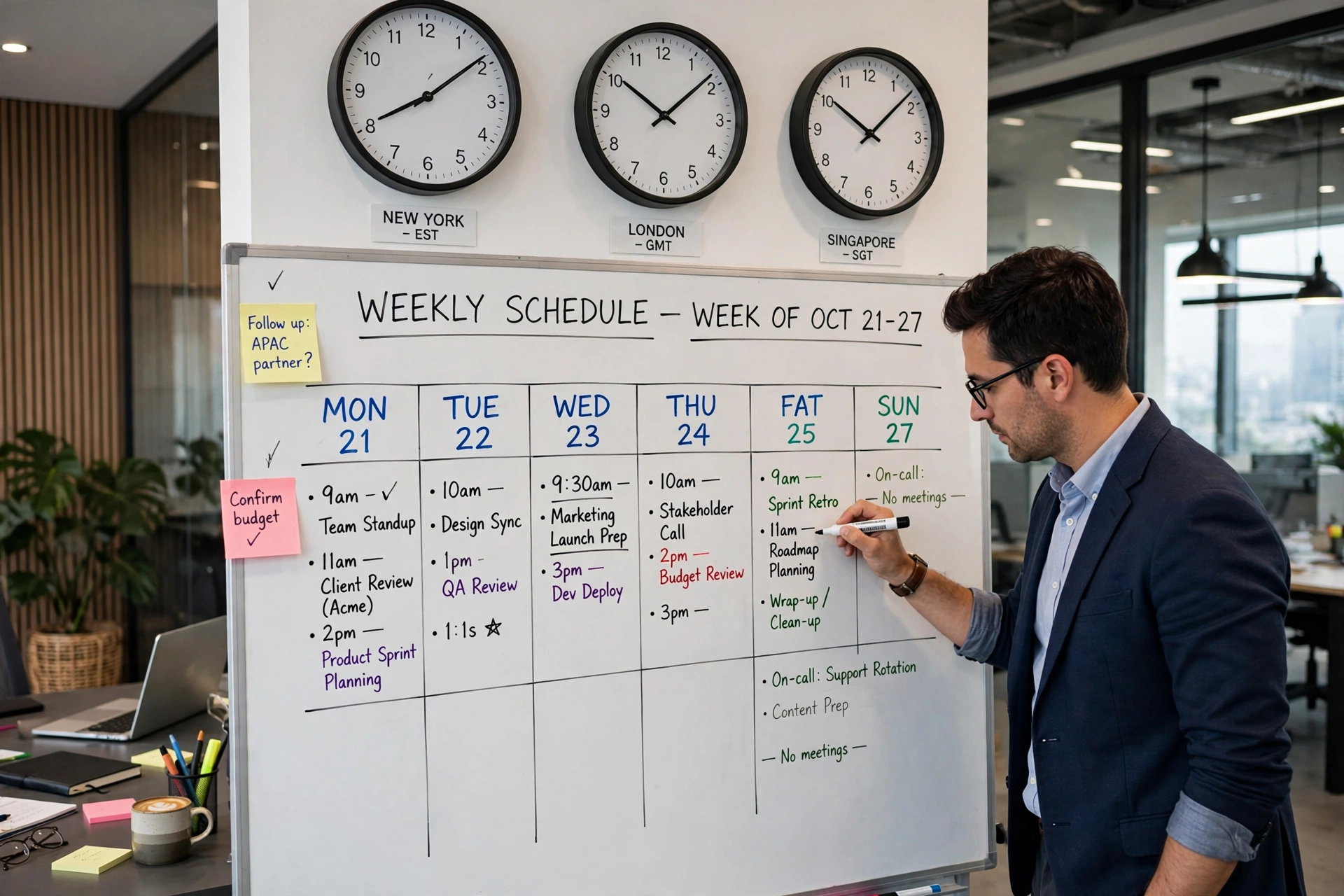
Async working fails when it means “reply whenever”. It succeeds when it means “reply within a known window, with enough context that nobody has to chase you”. Five rules carry most of the weight.
First, publish working hours. Every person lists their normal hours in their calendar and messaging profile, and the team treats those hours as the default. Messages outside them are fine; expecting a reply outside them is not.
Second, set response windows by channel, not by hope. For example: urgent incidents get a reply within the overlap window; ordinary messages get a reply within one working day; document feedback gets a reply within two working days. When everyone knows the window, nobody refreshes a chat channel anxiously at midnight.
Third, write decisions down where they can be found. A decision made in a call that half the team could not attend, and never written up, is a decision the absent half will unknowingly reverse. The rule is simple: no written record, no decision. The record needs the decision, the reasoning in two or three lines, the owner, and the date it takes effect.
Fourth, stamp every deadline with a time zone. “End of day Friday” means five different things on a global team. “Friday 5 p.m. London / 12 p.m. New York / 9 p.m. Dubai” means one thing. Shared calendars, time-zone settings in messaging tools, and scheduling links that display the invitee’s local time all reduce the same class of error.
Fifth, end every day with a handoff. The handoff note is the single highest-leverage habit for a team spread across time zones, and it deserves its own section below.
Build handoffs that let work move while a region sleeps
A good handoff answers five questions in a few lines: what changed today, what is done, what is blocked and by what, what should the next person do first, and who owns it now. A weak handoff says “progress made, see the document”. A strong handoff says “Draft complete and linked; waiting on legal sign-off from Priya, due Thursday; next step is to send the pricing table to the client once legal clears it; I am offline until 9 a.m. Singapore time”.

The follow-the-sun model only works when handoffs are this specific. A controlled experiment at Blekinge Institute of Technology found that follow-the-sun working with a daily overlap reduced time-to-market by 22% compared with co-located teams, while follow-the-sun without overlap improved it by only 10%. The overlap hour mattered because it let people hand work over in person, ask one clarifying question, and catch errors before they travelled around the world. Without that discipline, work handed across a time-zone boundary returns the next day with a misunderstanding attached, and the team loses a full cycle.
Managers should also build a handoff culture that rewards completeness over speed. A team member who writes a careful handoff at the end of their day is giving the next region a head start; a team member who rushes off without one is handing them a puzzle. Recognising the first behaviour explicitly, in team meetings and reviews, makes it stick far faster than any template alone.
Rotate the inconvenient meetings, and record everything
Fairness is where most time-zone systems quietly fail. If the weekly team meeting is always at a time that suits headquarters, the same colleagues absorb the cost every week, and over months that cost shows up as burnout, attrition and silence in meetings. The fix is rotation with a published schedule: move the recurring meeting through time slots so the inconvenience is shared, cap the number of recurring meetings any person must attend outside their normal hours, and record every meeting by default with a written summary.
Rotation needs a limit, not just a rota. A reasonable rule is that nobody attends more than one or two recurring meetings a month outside their normal hours, and that any meeting outside normal hours is genuinely necessary, time-boxed, and compensated in some visible way — for example, by starting later the next day. When a meeting cannot be rotated because a client or executive requires a fixed time, say so openly and share the burden in another way, such as exempting that person from the next early call.
Recordings and summaries serve a second purpose beyond fairness: they keep absent regions in the loop without requiring them to watch hours of video. A good summary is five lines: decisions made, actions assigned with owners and dates, open questions, and a link to the recording. Anyone who missed the call should be able to read the summary in two minutes and know exactly what changed.
Measure what is breaking, by region
Managers cannot fix what they only feel. Four metrics, reviewed monthly and broken down by region, reveal where a time-zone system is straining: handoff latency, meaning how long work waits between regions; decision cycle time, meaning how many days a decision takes from proposal to record; off-hours meeting load, meaning how many meetings each person attends outside their normal hours; and after-hours message share, meaning what proportion of messages arrive outside the recipient’s working hours. If one region’s decision cycle time is twice another’s, or one person’s off-hours load is triple the team average, the system — not the individual — needs redesigning.
Performance reviews need the same regional honesty. Judging a team member in a distant time zone by their presence in live meetings will always penalise them, because they are present less often by construction. Judge them by output, by the quality of their handoffs, and by the decisions they documented, and the evaluation becomes fair across the map.
A 30-day plan for a manager starting now
Week one: map the team, publish everyone’s working hours, and agree the overlap window and what it is reserved for. Week two: introduce the handoff template and the decision log, and move status updates out of meetings into writing. Week three: publish the meeting rotation, set response windows, and start recording meetings with written summaries. Week four: review the four metrics by region, ask the team directly who is carrying the time-zone cost, and adjust the window or the rotation in response. None of this requires new software. It requires a manager willing to protect the overlap window, write things down, and share the inconvenient hours fairly.
The bottom line
A remote team across time zones works when availability is explicit, live time is scarce and protected, writing carries the routine work, handoffs are specific, and the inconvenient hours rotate. The goal is not to pretend distance does not exist. It is to build a system in which distance stops deciding who gets heard, who gets promoted, and who burns out first.
Sources credited as text only: Microsoft Work Trend Index 2025; Organization Science time-zone communication study; Buffer State of Remote Work survey; Blekinge Institute of Technology follow-the-sun experiment.
Frequently asked questions
How many overlap hours does a remote team need?
Two to four hours a day covers most teams: enough for a standup, live problem-solving and unblocking, with the rest of the day running on written work. Teams with an 8-hour-plus spread may manage with one hour plus strong handoffs.
What should go in a handoff note?
What changed, what is done, what is blocked and by what, the next action, and who owns it now — plus when the writer returns. Five lines, specific enough that the next person can start without asking a question.
How do you make meeting times fair across time zones?
Rotate recurring meetings through time slots on a published schedule, cap out-of-hours meetings per person, record every meeting, and publish a short written summary so absent regions stay informed.