
eBay Selling Fees Explained: What the 13.6% Headline Rate Actually Costs You Per Sale
eBay selling fees look simple at first glance: a headline rate of 13.6% and a small per-order charge. The confusion starts when a seller’s first payout arrives and the amount kept by eBay is larger than 13.6% of the item price. That is not an error. eBay charges its main fee on the total amount of the sale, not just the price printed on the listing, and several optional charges can sit on top of it. Once you understand each layer, you can price with confidence instead of discovering the cost after the sale.
For wider context, see our guide to ecommerce trends.
This guide explains eBay selling fees for United States sellers in 2026, using the fee schedule as published on eBay’s own selling-fees pages and checked against independent fee guides in October 2026. Rates change from time to time, so always confirm your own category rate on eBay’s fee pages before you list, but the structure below is how the system works.
What eBay selling fees actually are
There are two fees that touch almost every seller. The first is the insertion fee, charged when you create a listing. The second is the final value fee, charged when the item sells. Everything else — store subscriptions, promoted listings, international fees and listing upgrades — is optional or conditional. If you only remember one sentence from this article, make it this one: the final value fee is the fee that matters most, and it is calculated on the item price plus the shipping charged to the buyer plus sales tax.
For most categories, the final value fee in 2026 is 13.6% of the total amount of the sale, up to $7,500 per item, plus 2.35% on the portion above $7,500. A per-order fee is added on top: $0.30 for orders of $10 or less, and $0.40 for orders over $10. Payment processing is included in that fee. Since eBay moved sellers to managed payments, there is no separate PayPal or card-processing charge added afterwards.
That distinction matters for pricing. If you sell an item for $50 and charge $10 for shipping, eBay does not take 13.6% of $50. It takes 13.6% of the combined total, plus tax collected on the order. Free shipping does not remove the fee either: the shipping cost is simply inside the item price instead, and the fee still applies to the whole amount the buyer pays.
A worked example: what eBay keeps on a $100 sale
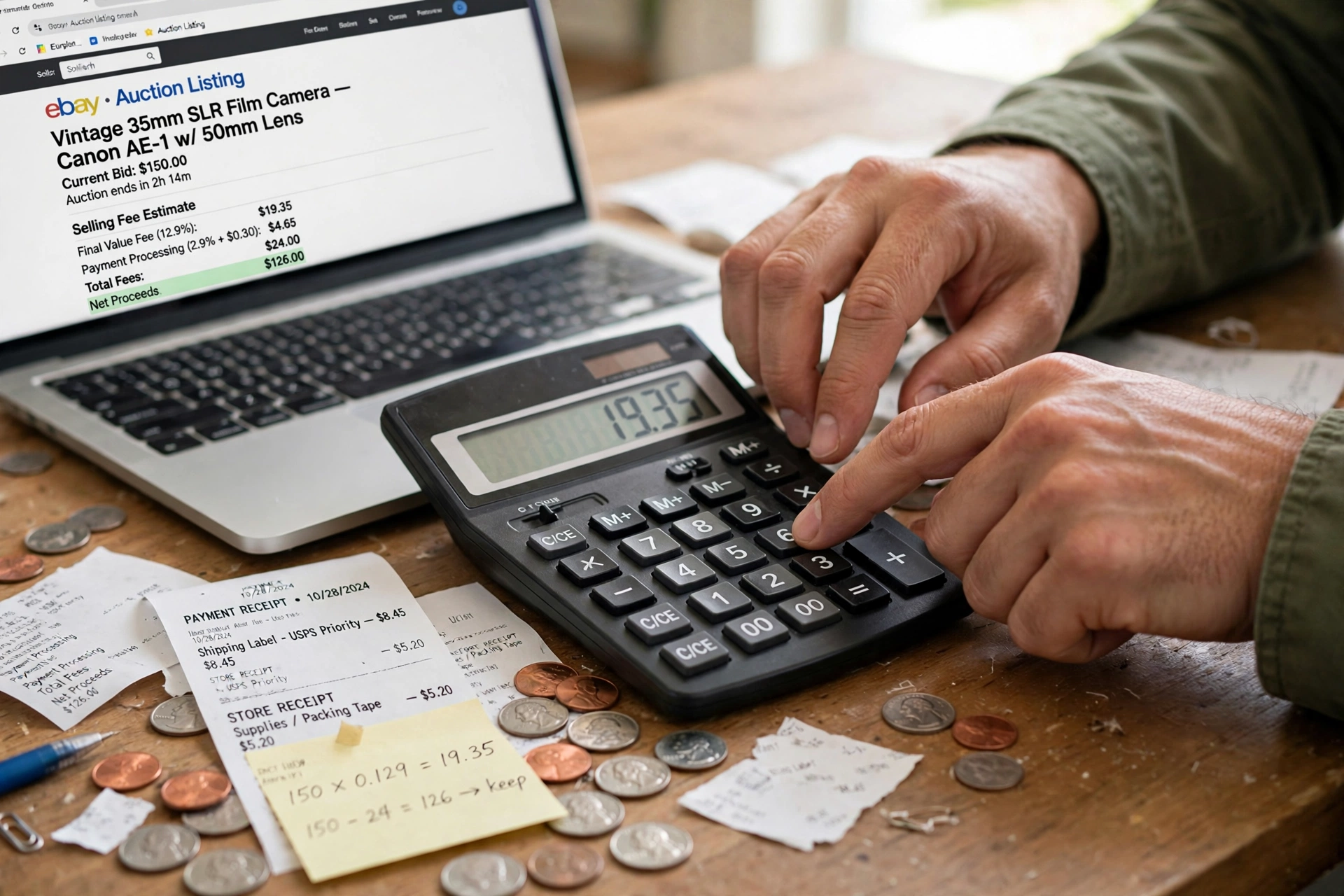
Take a straightforward sale: an item priced at $90 with $10 shipping, for a $100 total before tax, in a standard category, sold by a seller with no store subscription. Ignoring sales tax for a moment to keep the arithmetic visible, the final value fee is 13.6% of $100, which is $13.60, plus the $0.40 per-order fee, for a total of $14.00. The seller keeps $86.00 before the cost of the item itself, packaging and the actual postage.
Add sales tax and the picture shifts slightly. Suppose the buyer pays $8 in sales tax, making the total amount of the sale $108. The fee becomes 13.6% of $108, which is $14.69, plus $0.40, for $15.09. That is why two identical items can produce slightly different fees: the tax rate in the buyer’s state changes the base on which eBay’s percentage is calculated. eBay collects and remits sales tax in most states, but the fee is still charged on the tax-inclusive total.
Now try a smaller sale, because fees bite harder at low prices. An item sold for $15 with free shipping, again with no store, attracts 13.6% of $15, which is $2.04, plus $0.40, for $2.44. That is 16.3% of the sale price, not 13.6%. The flat per-order fee is the reason: on a $15 order it adds nearly three percentage points, while on a $100 order it adds less than half a point. Low-priced sellers need to build that fixed charge into their margins, or bundle items to lift the average order value.
Insertion fees: the first 250 listings are free
Every seller gets 250 free fixed-price listings per month. After that, each additional listing costs $0.35 in most categories if you have no store. That charge applies whether or not the item sells, and it renews if a listing runs for another period without selling. For a casual seller listing a handful of items, the insertion fee never appears. For a seller listing 500 items a month, the extra 250 listings add $87.50 before a single sale.
A store subscription raises the free allowance. A Starter store keeps the same 250 free listings, a Basic store raises it to 1,000, Premium to 10,000 and Anchor to 25,000. The per-listing charge after the allowance also falls as the tier rises, from $0.30 on Starter to $0.05 on Anchor. If you list in volume, the free allowance alone can justify a subscription even before any discount on the final value fee.
Store subscriptions: when the discount is real
eBay offers five store tiers, priced monthly or at a lower monthly rate when paid annually. On annual billing, Starter costs $4.95 a month, Basic $21.95, Premium $59.95, Anchor $299.95 and Enterprise $2,999.95. Paid monthly, the same tiers cost $7.95, $27.95, $74.95 and $349.95, with Enterprise available only on annual billing.
Here is the detail many sellers miss: a Starter store does not lower the final value fee at all. Its benefit is a storefront, a custom address and selling tools, not a discount. The discount starts at Basic. From Basic upward, the final value fee in most categories drops from 13.6% to 12.7% on the first $2,500 per item, with the rate above that unchanged. Some electronics categories fall further, for example to 9.35% for Basic-and-above sellers. Sellers who hold Top Rated Plus status also receive an automatic 10% discount on the final value fee in eligible categories, which stacks with the store discount.
The break-even arithmetic for Basic on annual billing is simple. The subscription costs $21.95 a month and saves 0.9 percentage points on sales. Dividing $21.95 by 0.009 gives about $2,439 in monthly sales in standard categories before the subscription pays for itself on fee savings alone. Below that volume, the extra free listings may still justify it; above it, the subscription is clearly worthwhile. The same calculation for a seller in consumer electronics, where the saving is more than four points, breaks even far sooner.
Promoted listings: the fee sellers choose, then forget
Promoted Listings Standard is the most common optional charge, and the most misunderstood. You choose an ad rate, commonly between 2% and 12% of the sale price, and you pay it only when a promoted listing sells. It is charged on top of the final value fee, so a 5% ad rate on a standard-category sale brings the combined eBay take to roughly 18.6% plus the per-order fee. Promoted Listings Advanced works differently: it charges per click on top search placements, whether or not the click leads to a sale, and it requires a store subscription.
The practical rule is to treat the ad rate as part of your margin, not as free visibility. If your margin after product cost, postage and the final value fee is 20%, a 10% ad rate halves it. Many sellers start at a low rate, measure which listings actually sell through promotion, and raise the rate only on items where the extra sales clearly outweigh the cost. Turning promotion on for every listing at a high rate is the fastest way to turn a profitable item into a loss-maker.
International sales, currency conversion and performance charges
Selling to buyers outside the United States adds two possible charges. An international fee of 1.65% applies to sales shipped internationally in many cases, although it is waived when the seller uses eBay International Shipping. Separately, when eBay converts currency for items listed or sold on another eBay site, United States sellers pay a conversion charge that rose from 3% to 3.25% on October 14, 2026. Neither charge affects a purely domestic seller, but both can surprise a seller whose first overseas order arrives.
Performance also has a price. Sellers evaluated as Below Standard face a surcharge on applicable sales in the following month, generally 6%, rising to 7% after four or more consecutive months at Below Standard under the schedule in force from July 1, 2026. That surcharge sits on top of the ordinary final value fee, which is why protecting seller standards — dispatching on time, resolving cases quickly, keeping tracking uploaded — is a financial discipline as well as a service one.
How to price so the fee does not eat your margin
Start from the price the buyer pays, not the price you wish you could charge. Work backwards: take your target sale price including shipping, subtract the final value fee at your category rate, subtract the per-order fee, subtract postage and packaging, subtract the product cost, and what remains is your margin. If that margin is too thin, you have four honest levers: raise the price, cut the product or postage cost, bundle items to spread the flat per-order fee across a larger order, or stop promoting the listing at a rate the margin cannot support.

One more pricing trap deserves a warning. Charging the buyer for shipping does not reduce your fee, because the fee is charged on shipping too. Offering free shipping and folding postage into the item price produces the same fee on the same total. The choice between the two should be made on conversion and buyer behaviour, not on a mistaken belief that one route avoids the fee.
eBay selling fees: the bottom line
For most United States sellers in 2026, eBay’s cost is 13.6% of the total sale plus $0.40 per order, with a lower 12.7% rate for Basic-store sellers and above, 250 free listings a month, and optional promotion and international charges on top. On a $100 sale that means about $14 kept by eBay before your own costs; on a $15 sale it means about $2.44, a higher percentage because of the flat charge. Price from the total the buyer pays, count the per-order fee, and let a store subscription earn its keep on volume. Do that, and the headline rate stops being a surprise.
Sources credited as text only: eBay Selling fees and Store selling fees help pages, as checked by independent fee guides in October 2026.
Frequently asked questions
Is the eBay final value fee charged on shipping and tax?
Yes. For most categories it is charged on the total amount of the sale: item price plus shipping charged to the buyer plus sales tax, up to $7,500 per item, plus a per-order fee.
Does a Starter store lower eBay fees?
No. Starter keeps the same final value fee as no store. The discount to 12.7% in most categories starts at the Basic tier.
How much does eBay take on a $100 sale?
About $14 with no store: 13.6% of $100 plus the $0.40 per-order fee, before your product and postage costs. Sales tax collected on the order raises the fee slightly because it raises the total.
Is payment processing extra on top of the final value fee?
No. Under managed payments, payment processing is included in the final value fee. There is no separate processor charge on top of it.